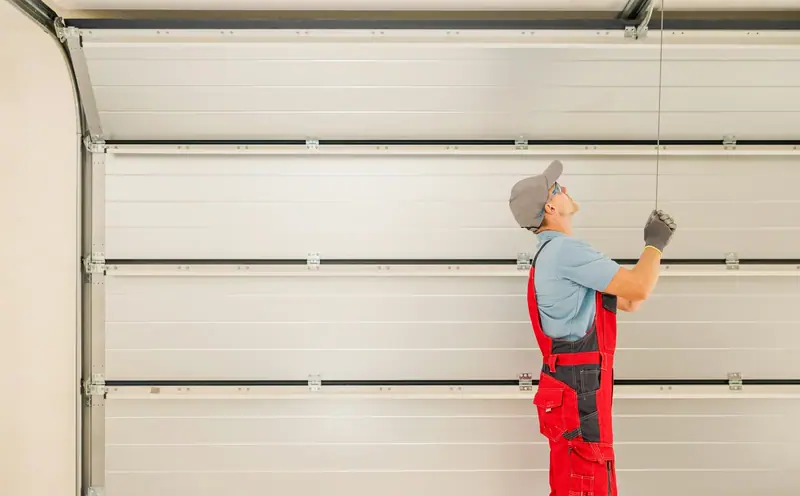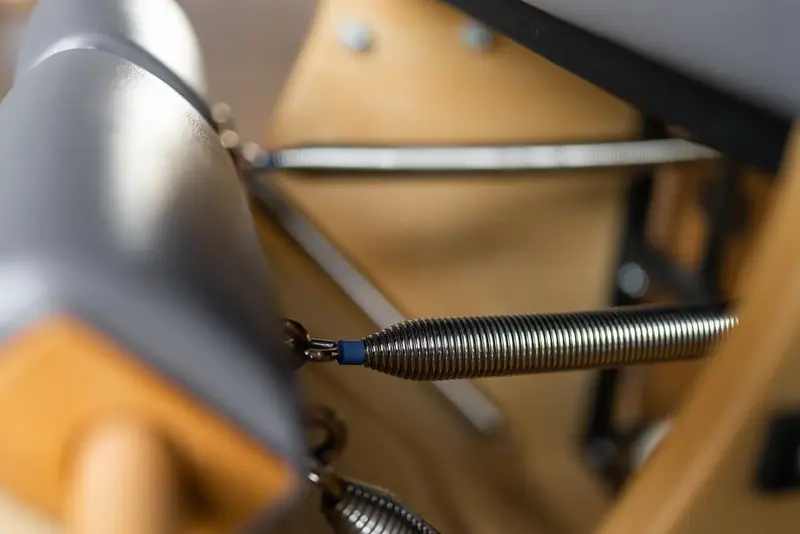
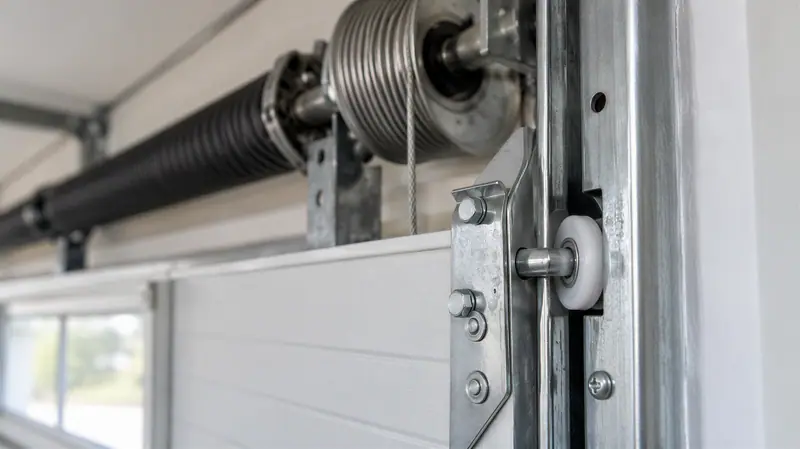
Look above your closed garage door from inside. If you see a steel shaft running across the top of the opening with one or two tightly coiled springs around it, you have a torsion system. It is the standard arrangement on most doors built in the last few decades, and it is the best one.
We replace torsion springs on residential doors throughout Nashotah and nearby. This page explains how the system works, how we choose the replacement, and the options worth knowing about.
How a torsion system lifts the door
Understanding the parts makes the repair easier to follow.
Torsion shaft
A steel tube or solid bar spanning the opening. Everything else mounts on it and turns with it.
Springs
Coiled around the shaft. One end is fixed to a center bracket, the other is clamped to the shaft with set screws.
Cable drums
Grooved wheels at each end of the shaft. The lift cables wrap onto them.
Lift cables
Steel cables from the drums down to brackets on the bottom corners of the door.
Bearings
A center bearing and two end bearings support the shaft and let it spin freely.
Winding and stationary cones
The cast fittings at each end of the spring. The winding cone has the holes for winding bars.
When the door is closed, the springs are fully wound. As the door rises, the springs unwind, turning the shaft and drums, and the cables take up the weight. When the door comes down, its weight winds the springs back up. A correctly matched spring makes the door feel like it weighs a few pounds at every point in its travel.
Signs a torsion spring is worn or broken
A broken spring is obvious: a bang, a visible gap in the coil and a door that will not lift. See broken spring repair for what to do in that moment.
A spring that is weakening is quieter about it:
- The door feels heavier when lifted by hand.
- It will not stay open halfway and drifts down.
- It slams the last foot when closing.
- The opener sounds strained or has started reversing.
- The coils look stretched, rusty or unevenly spaced.
Catching a spring at this stage lets you replace it on your schedule.
How we size a replacement
This is where care pays off. A torsion spring is defined by four things.
| Measurement | What it affects |
|---|---|
| Wire diameter | The stiffness of the spring. Small changes make a big difference. |
| Inside diameter | How the spring fits the shaft and cones, and its torque for a given wire. |
| Length | How many coils share the work, which sets the cycle life. |
| Wind direction | Left or right wound, depending on which side of the center bracket it sits. |
We do not simply copy the old spring. Doors get repainted, insulated, re-glazed and repaired over the years, and the previous spring may have been wrong to begin with. We check the door's weight, note the drum size and the door height, and select springs that deliver the correct lift.
For a two-spring door we replace both. On a one-spring door, we often recommend converting to a pair. Two springs share the load, the shaft is loaded more evenly, and if one breaks the other slows the door's descent.
Options worth considering
Cycle life
By choosing a longer spring in a heavier wire, the same lift can be achieved with less stress per cycle. Standard springs are rated around 10,000 cycles. High-cycle springs run to 25,000, 50,000 or beyond. If your garage door is your front door, the upgrade usually pays for itself.
Corrosion protection
Oil-tempered springs are the traditional dark gray type. They are strong and need occasional lubrication to keep rust away. Galvanized and powder-coated springs resist corrosion better and stay cleaner, which suits damp garages. Each has its advocates. We will recommend based on your garage.
New bearings and cones
If the end bearings are rough or the center bearing is worn, this is the time to replace them. They are inexpensive, and a gritty bearing shortens spring life and makes noise.
The replacement, step by step
- 01
Lock the door down
Locking pliers or clamps go on the track above a roller, and the opener is disconnected from the door.
- 02
Unwind any live spring
Using two solid steel winding bars, the remaining tension is released a quarter turn at a time.
- 03
Loosen and slide the hardware
Drum set screws are loosened, cables are unhooked and the shaft is freed so the old springs can come off.
- 04
Inspect shaft, drums and bearings
We look for a bent shaft, cracked drums, worn bearings and frayed cables, and replace what is needed.
- 05
Fit the new springs
New springs slide on in the correct orientation, the center cones are bolted to the bracket, and drums and cables are reset evenly.
- 06
Wind to specification
Each spring is wound to the calculated number of turns for the door height, then the set screws are tightened to the proper torque.
- 07
Balance test
With the clamps off, the door is lifted by hand. It should rise easily, hold at mid-height and rest gently when closed.
- 08
Lubricate and reconnect
The coils get a light coat of lubricant, the opener is reconnected and its force and limits are checked.
Before & after
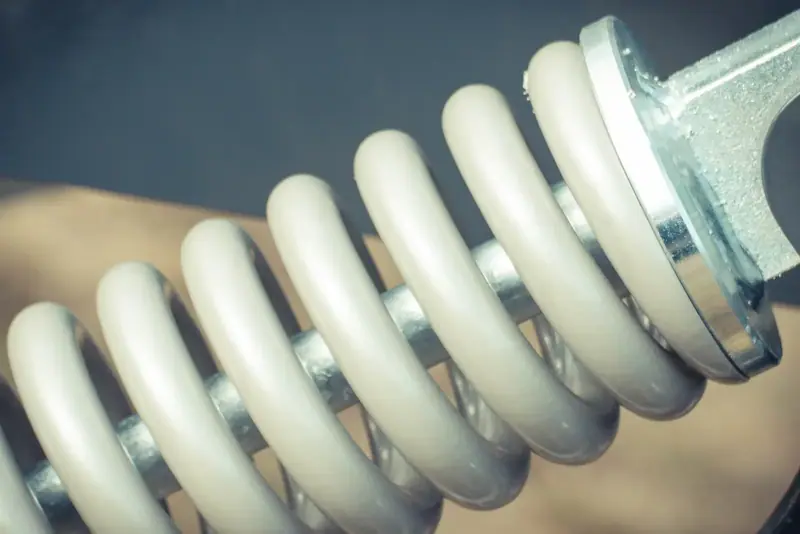
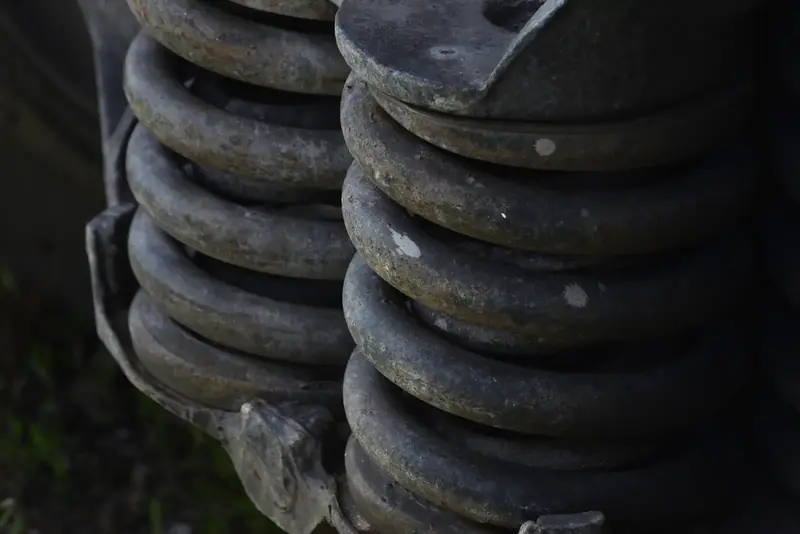
Fatigued torsion springs compared with a new coated spring
Project notes
The springs in the first image are typical of a door that has done its ten thousand cycles and more. The coils are dark and dry, there is rust in the gaps, and the spacing has become uneven where the steel has taken a set. A spring in this state has lost lift, so the door feels heavy and the opener labors.
The illustrated replacement is a new spring with a protective coating, uniform coil spacing and fresh winding and stationary cones. It is selected to match the door's weight and the drum size, and it is wound to the calculated number of turns.
The benefits are immediate and measurable: the door holds at any height by hand, the opener draws less current, and with a coated, higher-cycle spring the next replacement is a long way off.
Illustrative example. These are licensed reference photographs chosen to show the kind of change this service makes. They are not photos of a specific Nashotah Garage Door customer's property.
Getting the balance right
Balance is the test of the whole job. We check it in three positions.
- A foot off the floor. The door should stay or settle very gently.
- Waist height. It should hold steady without rising or dropping.
- Fully open. It should stay up without being pulled into the header or creeping down.
If the door rises on its own, the springs are overwound. If it drops, they need more tension or a stronger spring. Small adjustments are made a quarter turn at a time until the door is neutral.
A balanced door is a safe door. It is also what lets the opener's safety reversal work as designed, because the opener can only sense an obstruction reliably when it is not already fighting the door's weight.
Torsion springs in a Wisconsin garage
Cold. Spring steel stiffens slightly in the cold and loses a little effective lift. A door balanced in a warm garage in August can feel a touch heavy at ten below. We allow a small margin, and an annual check before winter keeps it right.
Moisture. Wet cars, snowmelt and lake air all raise the humidity in a garage. Bare springs rust, and rust shortens their life. A coated spring and a spray of lubricant in the fall are simple defenses.
Usage. In many homes here the garage is the everyday entrance, especially in winter when nobody wants to walk around to the front. That drives cycle counts up, and it is the main reason we talk to people about higher-cycle springs.
Timing. Springs near the end of their life tend to break when it is coldest. If yours are original and getting on in years, replacing them in the fall beats an emergency in January.
Converting from extension to torsion
If your door currently uses extension springs along the side tracks, it can usually be converted to a torsion system. The conversion adds a shaft, drums, bearings and a center bracket above the door, and needs adequate headroom. The benefits are smoother travel, better balance, a longer-lasting spring and a safer failure mode. We can assess your garage for it. The extension spring replacement page covers when it makes sense.
Why this is a job for a professional
A torsion spring is wound with thirty or so quarter turns on a standard seven-foot door, storing a great deal of energy. If a winding bar slips out of the cone, or a set screw is loosened in the wrong order, that energy is released instantly. Proper bars that fit the cone, a clamped door, a clear stance out of the bar's path and a fixed sequence are what keep the job safe. Screwdrivers and lengths of rebar are how people get hurt.
A professional also carries a range of springs and can match your door on the spot, and will check the cables, drums and bearings that share the shaft. The spring is rarely the only thing that has aged.
Frequently asked questions
Standard springs are rated for about 10,000 cycles, which is roughly seven years at four cycles a day. High-cycle springs last two to five times longer.
We can, but we advise against it. The surviving spring has the same wear and will fail soon, and mismatched springs do not balance the door well.
A spring made with more steel, so each cycle stresses it less. It provides the same lift and lasts much longer.
For wider and heavier doors, two springs are better. They share the load and give you a margin of safety if one breaks. We will advise based on your door.
Yes, lightly, once or twice a year with a garage door lubricant. It reduces friction between coils and protects against rust.
You do not need to. We measure the existing springs, check the door weight and select the right ones. Please do not try to measure a wound spring yourself.