Garage door openers are remarkably durable. It is common to find one that has outlasted two cars, a furnace and a roof. That durability is a mixed blessing, because many of those veterans are still running long after they should have been retired.
We replace garage door openers for homeowners in Nashotah and the neighboring communities. Here is how to tell when replacement beats repair, and what a modern unit gives you.
Reasons to replace an opener
Safety
This is the one that should not wait. Since 1993, residential openers sold in the United States have been required to include a secondary entrapment protection system, in practice the pair of photo-eyes near the floor. An opener made before then, or one whose sensors have been removed or bypassed, relies on contact reversal alone, and on older units that function is often weak or unreliable.
If your opener has no sensors at the bottom of the door tracks, or fails the simple test of reversing when it closes on a flat board, it should be replaced.
Security
Early remotes used a fixed code set by a row of small switches. Anyone with a matching remote, or a code grabber, could open the door. Rolling-code technology, standard for many years now, changes the code on every press. If your remote has switches inside it, the opener is from the fixed-code era.
Noise
Older chain-drive openers with AC motors start at full speed, clatter along and stop abruptly. Under a bedroom, that is the sound that wakes people. A belt-drive DC unit is a different experience.
Reliability and parts
When a logic board or motor fails on a unit of a certain age, the part can cost a large share of a new opener, if it is available at all. At that point money spent on repair is poorly spent.
Features
Battery backup, phone control, automatic closing, brighter lighting and integrated locks are all things older openers cannot provide.
Repair it or replace it?
| Your opener… | Our advice |
|---|---|
| Has no photo-eyes | Replace |
| Uses switch-coded remotes | Replace |
| Is under 12 to 15 years old with a worn gear or capacitor | Repair is reasonable |
| Needs a logic board and is over 15 years old | Usually replace |
| Works but is too loud for the house | Replace with belt drive or wall mount |
| Keeps reversing in cold weather | Check the door first. Often a door problem, not the opener. |
| Has a failed motor | Replace |
| Works fine, and you want smart features | An add-on controller may do. See below. |
We repair openers too, and we will tell you plainly if yours is worth it. See opener repair.
What you gain with a modern opener
Quiet operation
Belt drives and DC motors with soft start and stop. Much of the noise is simply gone.
Reliable reversal
Electronic force sensing that monitors the door throughout its travel, plus photo-eyes.
Secure remotes
Rolling codes, and the ability to erase lost remotes from memory.
Battery backup
The door still works when the power is out.
Phone control and alerts
Know whether the door is open, and close it from anywhere.
Better light
Integrated LED lighting that covers the whole garage.
Lower standby power
Modern units draw very little while idle.
Automatic locking
On some models, a deadbolt engages every time the door closes.
Choosing the replacement
The options are the same as for a first-time installation, and the opener installation page covers them in detail. In brief:
- Belt drive for attached garages and anywhere quiet matters.
- Chain drive for detached garages where noise is not a concern and budget is.
- Wall-mount jackshaft for high ceilings, overhead storage, or when you want the ceiling clear. Requires a torsion spring door.
We size the unit to your door's weight and height. Doors taller than seven feet need a longer rail or an extension kit.
How the replacement is done
- 01
Assess the door
We disconnect the old opener and test the door by hand. Balance, springs, rollers and track are checked, and any issues are discussed before the new unit goes in.
- 02
Remove the old system
Motor unit, rail, door arm, wall control, sensors and old wiring are taken down.
- 03
Inspect the mounting points
The header bracket location and ceiling supports are checked. Flimsy strap is replaced with braced angle iron.
- 04
Reinforce the door if needed
A proper opener bracket and top-section strut are fitted if the old installation lacked them.
- 05
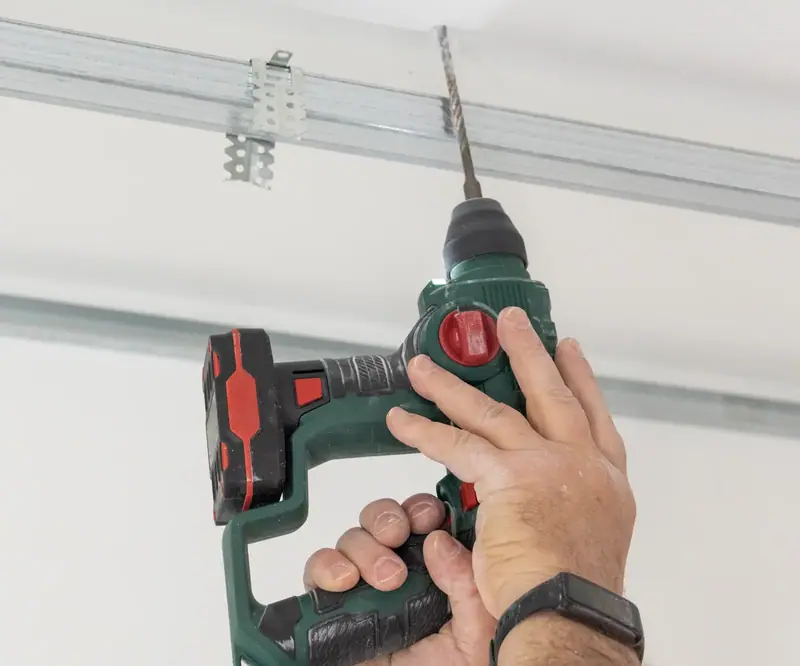
Install the new opener
Rail, power head and arm are mounted, centered and leveled.
- 06
Fit new photo-eyes and controls
We install the sensors and wall console supplied with the new unit. Old wire is replaced if it is damaged or incompatible.
- 07
Set travel and force
Limits are set so the door seals gently, and force is set to the minimum that operates the door.
- 08
Test the safety functions
Contact reversal, beam interruption and manual release.
- 09
Program remotes, keypad and app
New remotes are paired, vehicle built-in buttons are programmed, and the old remotes are retired.
- 10
Remove the old unit
The old opener and packaging leave with us.
Most replacements take two to three hours.
Before & after
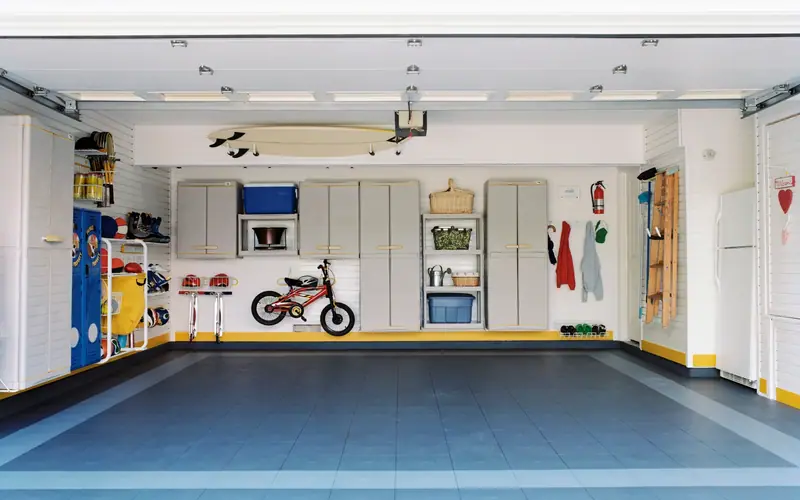
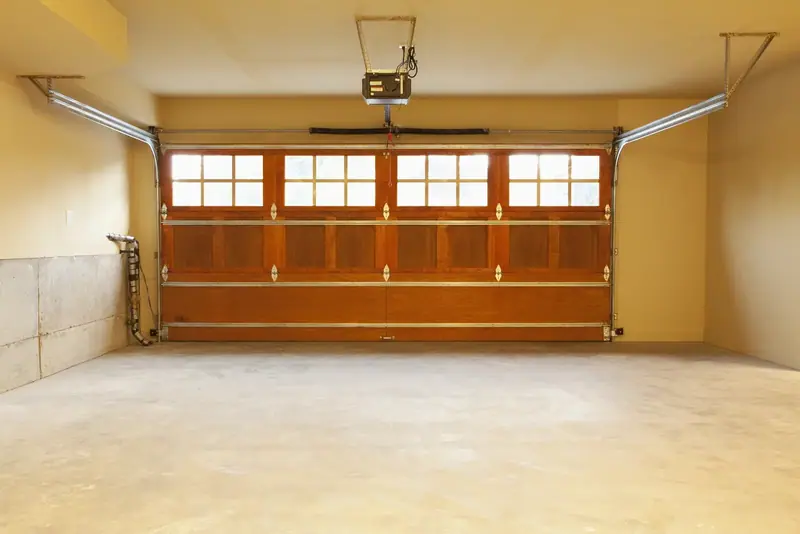
A dated opener in an older garage compared with a tidy modern setup
Project notes
The first image shows a garage many homeowners will recognize: an older door, and above it an opener that has been in place for a long time. Units of that generation are often chain driven with an AC motor, and they start with a jolt, run loudly and may have limited safety features.
Replacement means taking down the old motor unit, rail, wall control and wiring, and installing a current opener on proper supports with new photo-eyes, a new wall console and new remotes. The door's balance is corrected first so the new unit is not handed the old one's problems.
The comparison illustrates the finished kind of space: an opener that runs quietly, lights the garage, reverses reliably on contact and on a broken beam, and can be checked from a phone. The old remotes and their codes are retired along with the old unit.
Illustrative example. These are licensed reference photographs chosen to show the kind of change this service makes. They are not photos of a specific Nashotah Garage Door customer's property.
Can any of the old parts stay?
People often ask whether the existing rail, sensors or wall button can be reused to save money. As a rule, no. Openers are designed as systems, and sensors and wall controls from one generation or brand frequently will not communicate with another. The rail is matched to the power head and drive type. Reusing old low-voltage wire is sometimes possible if it is sound and correctly rated.
What does stay is everything about the door itself, provided it is in good order, and the ceiling outlet.
Adding smart control without replacing
If your opener is fairly recent, has photo-eyes and works well, you may not need a new one to get phone control. Add-on controllers connect to many existing openers and provide remote monitoring and operation. We can check compatibility and fit one. If the opener is old enough to lack modern safety features, though, an add-on is not a good investment. Put the money toward a replacement. See smart opener installation.
Replacement considerations in Wisconsin
Cold starts. Older AC openers with stiffened grease struggle in an unheated garage at ten below. DC units handle cold better and compensate for the extra resistance of a cold door without the force having to be turned up unsafely.
Outages. Winter ice and summer storms both knock out power. If the garage is your main way in, battery backup deserves serious thought. See battery backup installation.
Rooms over garages. Common in homes around here, and the main reason people ask for a quieter opener. Belt drive plus vibration isolators on the mounts makes a marked difference. See noise reduction.
Heavier insulated doors. If you have replaced a light door with an insulated one, the old opener may be working harder than it was designed to. A unit matched to the new door will last longer.
Lake and seasonal homes. Being able to check from the city that the garage is closed, or to let a contractor in for an hour, is useful for a property you are not at every day.
Why professional replacement matters
Taking down an old opener and bolting up a new one sounds simple, and physically it is. The value is in what goes around it.
We find out why the old opener failed. Very often the door was out of balance and had been overloading it for years. Installing a new unit on that same door starts the same decline.
We set the closing force and test the reversal properly. The safety standard that makes modern openers safe assumes they are installed and adjusted correctly. Sensors mounted too high, or force set too strong, quietly undo it.
And we deal with the old remotes, the wiring and the mounting so the result is tidy, secure and solid.
Frequently asked questions
If it has no sensors near the floor, uses remotes with small switches inside, or dates from before the mid-1990s, it should be replaced on safety and security grounds.
No. New openers use different radio technology. New remotes come with the unit, and we can program built-in vehicle buttons and keypads.
It will remove opener noise. If the door itself has worn rollers or loose hardware, those need attention too. We check both.
Usually two to three hours.
Not at all. Provided the door is balanced and sound, a new opener can be fitted to it.
We remove it and take it away with us.