A residential door that sticks is an irritation. A commercial door that sticks is a problem with a price attached. A delivery waits. A vehicle cannot leave. A heated building stands open to the weather, or a site cannot be locked.
We repair commercial garage doors for businesses in and around Nashotah, from contractor shops and auto bays to storage buildings and farm operations. This page covers sectional overhead doors. Rolling steel and roll-up doors have their own pages.
Commercial doors are a different animal
They look like large house doors. The engineering is on another scale.
| Typical residential door | Typical commercial sectional door | |
|---|---|---|
| Size | 8 to 16 ft wide, 7 or 8 ft high | 10 to 30 ft wide, 10 to 24 ft high or more |
| Weight | 130 to 350 lb | 400 lb to well over 1,000 lb |
| Track | 2-inch, lighter gauge | 2-inch or 3-inch, heavy gauge, often high-lift or vertical-lift |
| Springs | 10,000-cycle standard | 25,000 to 100,000-cycle options |
| Daily cycles | 3 to 6 | Anywhere from a handful to hundreds |
| Operation | Light-duty opener | Chain hoist or a commercial operator |
The higher weights and spring tensions mean the stakes are higher too. Commercial door work is not something to hand to a general maintenance crew.
What goes wrong
Broken springs
The most common failure. Commercial doors may have two, four or more torsion springs. When one breaks the door becomes extremely heavy or will not move.
Frayed or snapped cables
Larger-diameter cables carrying much greater loads. A failure can drop one side of the door.
Impact damage
Forklifts, trucks and trailers hit doors and tracks. Bent track and creased sections are routine in busy buildings.
Worn rollers and bearings
Heavy use wears them out. Seized rollers drag and damage the track.
Damaged sections
Bottom sections take most of the hits. Rust, dents and cracks at the stiles.
Bent or loose track
From impact or from fasteners working out of masonry and steel.
Failed weather seals
Large perimeters lose a great deal of heat when seals go.
Operator faults
Brake, limit, clutch and control problems. See door operator repair.
Safety device faults
Photo-eyes and sensing edges that stop the door closing.
Signs a door needs attention soon
Catching a problem early is far cheaper than an emergency call-out.
- The door has become harder to lift by hand or by chain.
- It drifts down when left partly open.
- It travels unevenly, or one side leads the other.
- New noises: grinding, banging, scraping.
- Visible gaps in a spring, or broken cable strands.
- Daylight around the edges that was not there before.
- The operator runs longer, hotter or louder than it used to.
- Sections that have bowed or cracked.
If staff are having to force or assist the door, stop using it. That is how minor faults become injuries.
Our approach to a commercial repair call
- 01
Understand the urgency
Is the door stuck open or closed? Is a vehicle trapped? Is the building secure? This sets priorities.
- 02
Make the door safe
The door is secured against movement and the operator is locked out before anything else is touched.
- 03
Diagnose the whole system
Springs, cables, drums, shaft, bearings, rollers, hinges, track, sections, seals and operator are inspected. Commercial doors rarely have just one tired part.
- 04
Explain and quote
You get a clear description and a price, with what must be done now separated from what can be planned.
- 05
Repair with the right components
Springs calculated to the door's weight and required cycle life, cable and hardware of the correct rating.
- 06
Balance and adjust
The door is balanced so the operator or chain hoist is not carrying its weight, and limits are reset.
- 07
Test the safety systems
Reversing devices and controls are tested.
- 08
Brief your staff
We explain what was done and anything operators should watch for.
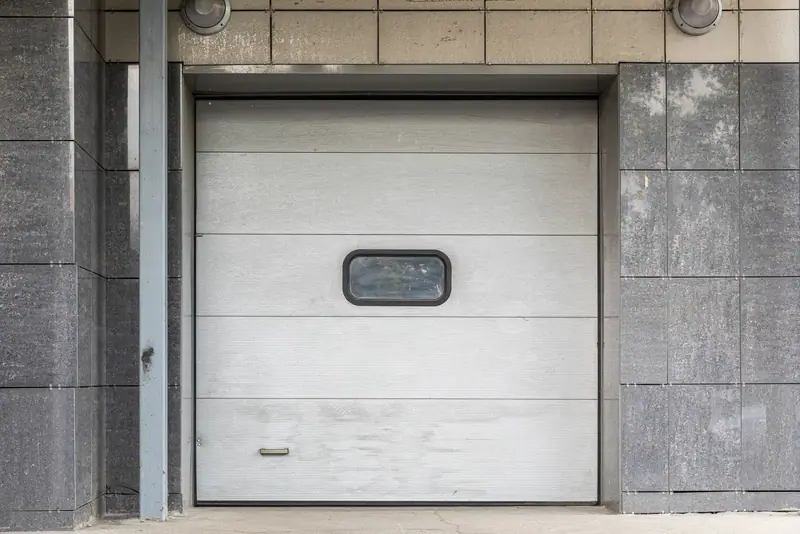
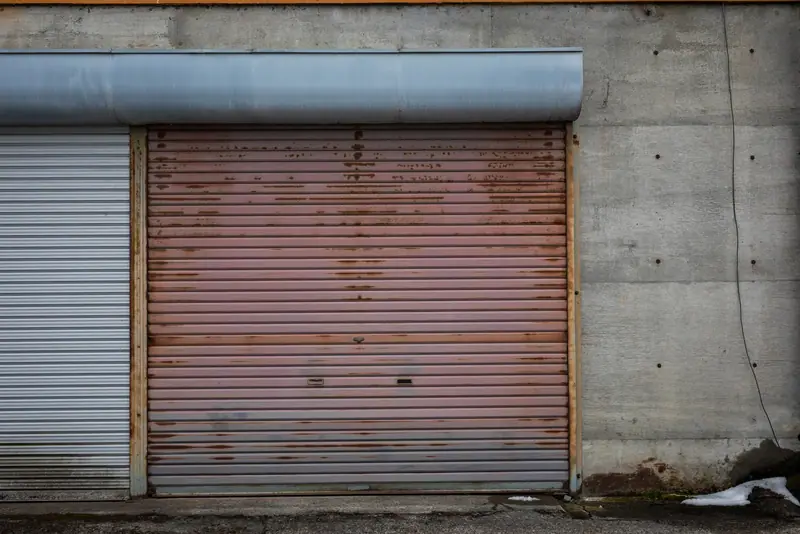
Before & after
A rusted, failing commercial door compared with a sound sectional door
Project notes
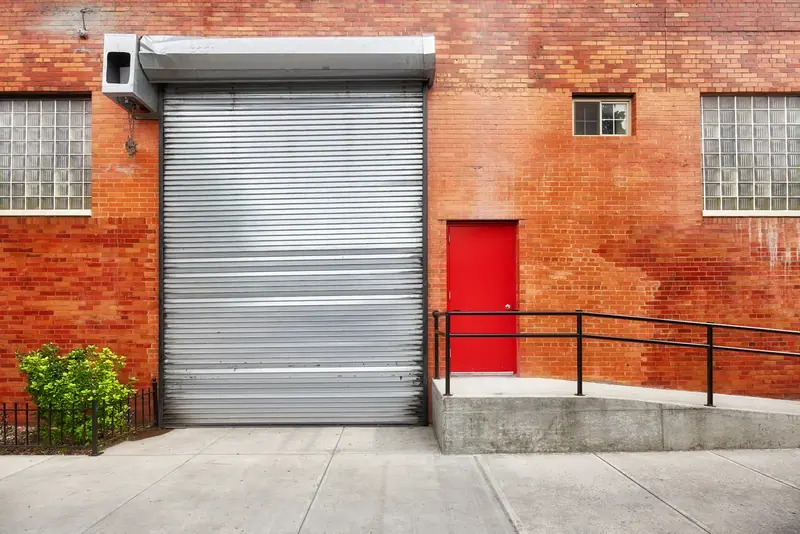
The first image shows a commercial door at the end of a hard life. Rust has spread across the curtain, the door no longer moves freely and the building's security depends on something that may not open, or close, on any given day. Doors reach this state gradually, usually without any maintenance along the way.
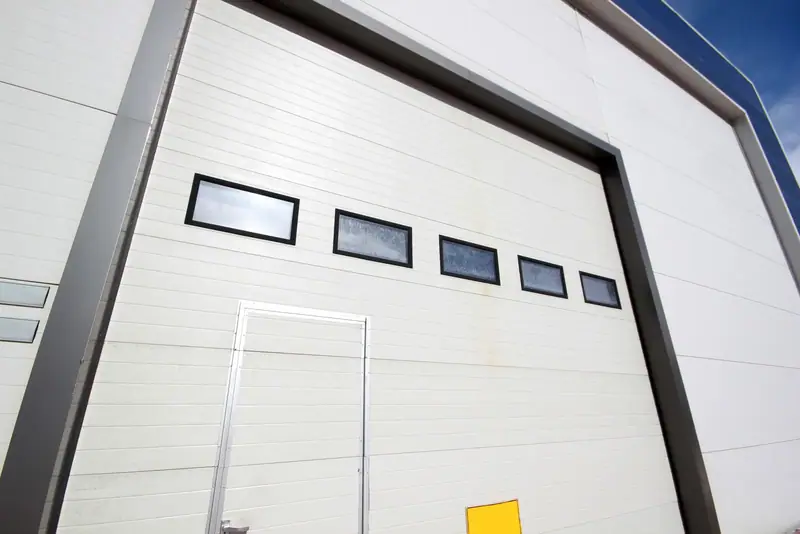
The comparison illustrates a commercial sectional door in sound working order: straight sections, a clean finish, a vision panel so staff can see what is outside, and hardware that carries the door's weight properly. Depending on what we find, getting a failing door back to this standard may mean new springs, cables, rollers and track repairs, replacement of damaged sections, or, when the door is too far gone, a new door.
For the business the result is simple. The opening can be used on demand, secured at night and operated without anyone having to force it.
Illustrative example. These are licensed reference photographs chosen to show the kind of change this service makes. They are not photos of a specific Nashotah Garage Door customer's property.
Springs: where to spend a little more
A commercial door's springs determine how often you will be calling for repairs. They are specified by cycle life, and the difference in cost between ratings is small compared with the cost of downtime.
As a rough guide to choosing:
- Under 10 cycles a day: a 25,000-cycle spring gives several years of service.
- 10 to 30 cycles a day: 50,000 cycles or more is sensible.
- Heavy traffic, such as a busy service bay: 100,000-cycle springs, or a review of whether a different door type would suit better.
We calculate replacements from the door's actual weight. Doors change over time. Sections get replaced, insulation and struts get added, and the original springs may never have been quite right. We also replace springs as a complete set so the door stays balanced.
Repair or replace?
We will always repair a door that merits it. Replacement becomes the better business decision when:
- Several sections are damaged or rusted through.
- Parts for the door are no longer made.
- The door is uninsulated on a heated building and the energy loss is significant.
- Repair costs over the past couple of years add up to a good share of a new door.
- The door no longer suits how the opening is used, for instance more traffic than it was built for.
When that is the case we will show you the figures both ways. See overhead door installation.
Commercial doors in Wisconsin conditions
Cold and energy. A large door on a heated shop is the building's biggest thermal weak point. Worn perimeter seals and a damaged bottom seal can cost real money over a winter. Seal repairs often pay for themselves in a season.
Ice at the threshold. Meltwater from vehicles freezes along the bottom of the door. An operator pulling against a frozen-down door can snap cables, bend the top section or damage itself. Staff should know to check before pressing the button on a hard-frost morning.
Salt. Trucks and plows bring in salt. Bottom sections, bottom brackets, cables and the lower track corrode quickly. Washing down in spring and replacing rusted bottom fixtures promptly prevents larger failures.
Wind. Big doors catch a lot of wind, particularly on open sites and near the lakes. Missing or damaged struts let sections bow, and a bowed door can leave its tracks.
Thermal movement. Long steel doors and tracks move noticeably between summer and winter. A door adjusted tightly in July may bind in January. We allow for it.
Agricultural buildings. Dust, humidity from livestock, and washdown water are hard on hardware. Galvanized and stainless components, and more frequent lubrication, are worth specifying.
Keeping a repaired door repaired
The pattern we see most often is a door that receives no attention until it fails, is repaired, and receives no attention again. A simple maintenance schedule breaks that cycle. Lubrication, hardware checks, balance tests and spring cycle tracking let you replace parts on a planned visit instead of a breakdown. Details are on the commercial maintenance page.
It also helps to give one person on site responsibility for reporting door problems, and to keep operators from forcing a door that is not behaving.
Why this needs a specialist
The forces involved in a commercial door are several times those of a house door. A broken spring assembly or a snapped cable on a twelve-foot-high door is dangerous in a way that needs no exaggeration. Safe repair requires locking out the operator, supporting the door, using properly sized winding bars and following a set procedure.
There is also liability to think about. A door that is repaired and adjusted by a specialist, with its safety devices tested, is a door you can stand behind if anyone ever asks.
Frequently asked questions
Sectional overhead doors of the kind found on shops, warehouses, service bays and agricultural buildings, along with rolling steel and roll-up doors and commercial operators, each of which has its own page.
It depends on our schedule and the nature of the problem. Tell us if a vehicle is trapped or the building cannot be secured, and we will give you an honest answer on timing.
Usually. Bent track is replaced, damaged sections are replaced or reinforced, and the door is rebalanced. Severe damage across several sections may justify a new door.
It depends on the cycle rating and how often the door is used. We can estimate remaining life from your usage and recommend a rating that fits.
Only if the springs and cables are intact and the door is balanced. A door with a broken spring is far too heavy and should be left alone.
We can set up a regular maintenance schedule suited to how hard your doors work. See commercial maintenance.