You press the button and something other than the usual happens. The motor hums and the door stays put. The door goes down a foot and comes back up. The light blinks ten times. Or nothing at all.
We repair garage door openers for homeowners in Nashotah and the surrounding communities, across the common brands and drive types. Our starting point is always the same, and it is not the opener.
Door first, opener second
An opener is designed to move a balanced door. If the springs are carrying the door's weight properly, the opener only has to overcome a few pounds of friction. When the springs weaken or something binds, the opener is suddenly asked to lift real weight, and it responds by straining, reversing or wearing out.
So before we open the opener's cover, we pull the release cord and run the door by hand. If it is heavy, sticks, or will not stay halfway, the door needs fixing first. Repairing the opener without correcting the door just sets up the next failure.
Symptoms and likely causes
| What happens | Usual cause |
|---|---|
| Motor hums or runs, door does not move | Stripped drive gear or sprocket, broken coupling, or the trolley is disengaged |
| Clicks once and nothing happens | Failed start capacitor, stuck relay or seized motor |
| Completely dead | No power at the outlet, blown fuse, failed board or transformer |
| Door reverses on the way down | Photo-eyes blocked or misaligned, door binding, or force set too low |
| Door reverses just as it reaches the floor | Down travel limit set too far |
| Door stops short of the floor or the top | Travel limits out of adjustment |
| Opens by itself or will not respond | Stuck wall button, shorted wire, or remote interference |
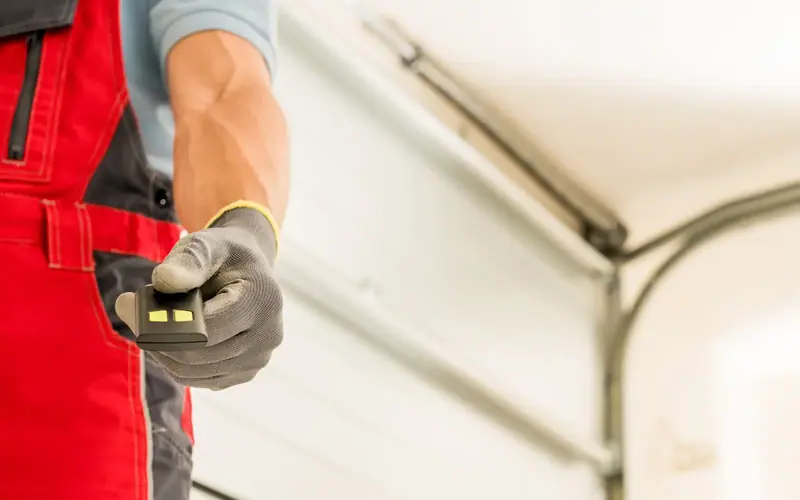
| Remote works only up close | Weak battery, damaged antenna or radio interference |
| Very loud grinding | Worn gear, dry rail or a failing bearing |
| Chain or belt sagging and slapping | Tension needs adjusting |
| Lights flash a pattern | Diagnostic code. The count identifies the fault. |
The parts that commonly fail
Drive gear and sprocket
Many chain and belt openers use a nylon gear that is designed to wear before the motor does. When the door is heavy, it strips. White plastic shavings inside the cover are the giveaway.
Trolley or carriage
The sliding part that connects the rail to the door arm. It wears, cracks or loses its grip on the chain or belt.
Start capacitor
Gives an AC motor its kick at start-up. A failed one leaves a hum and no movement.
Logic board
The opener's controller and radio receiver. Vulnerable to power surges and lightning.
Limit switches or travel module
Tell the opener where open and closed are. They drift or fail.
RPM or position sensor
Lets the opener detect an obstruction. A faulty one causes random stops and reversals.
Chain, belt or screw
Stretch, wear or dry out, and need adjusting, lubricating or replacing.
Wiring
Staples through the low-voltage wire, corroded connections and rodent damage are all common.
Most of these are repairable at a sensible cost if the opener is of reasonable age and parts are still supplied.
How we diagnose and repair
- 01
Hear the story
What it does, when it started and whether anything changed recently, such as a storm, a power cut or a new noise.
- 02
Test the door by hand
With the opener released we check weight, balance and smooth travel. Any door problem is noted and discussed.
- 03
Check power and controls
Outlet, wall console, wiring, remotes and the photo-eyes and their indicator lights.
- 04
Read the diagnostics
Most modern openers report fault codes through an LED or flashing lights.
- 05
Open and inspect the unit
Gear, sprocket, capacitor, board, travel mechanism and motor are examined.
- 06
Explain and price
You get the diagnosis, the repair cost and, where relevant, how that compares with a new unit.
- 07
Repair and adjust
Faulty parts are replaced, the rail is lubricated as the maker specifies, and chain or belt tension is set.
- 08
Set limits and force, then test
Travel is set so the door seals without straining. Reversal is tested with an obstruction and by breaking the sensor beam.
Before & after
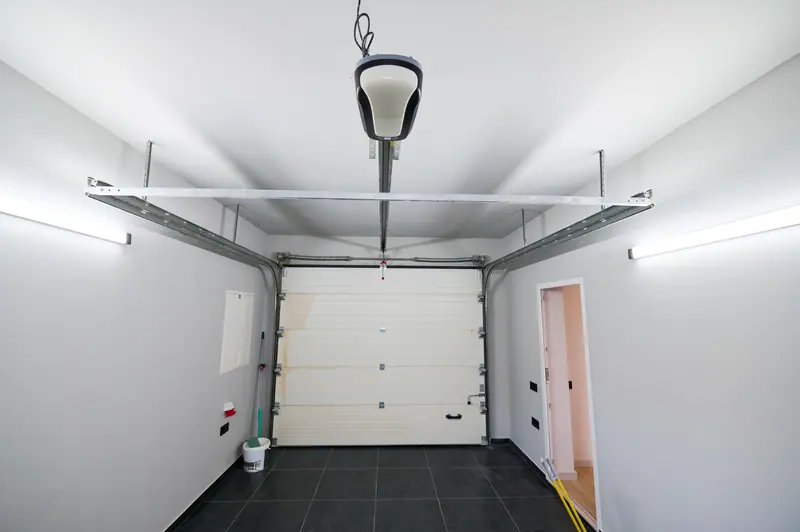
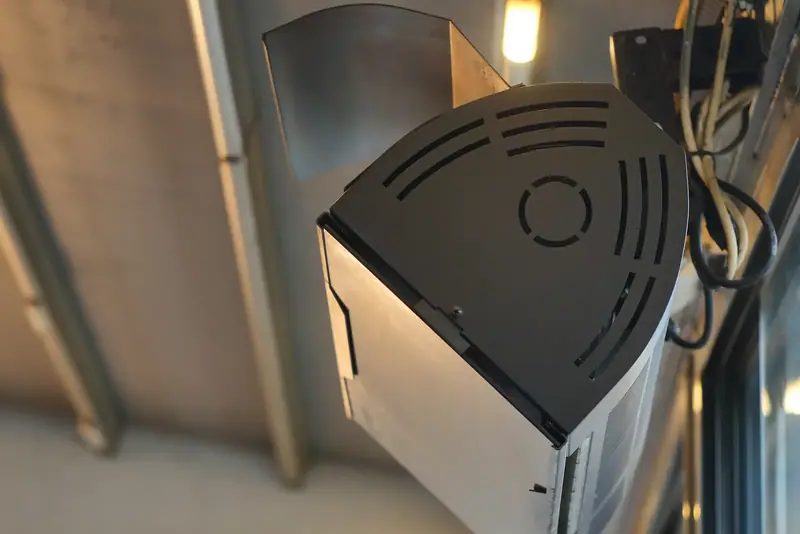
An aging ceiling unit compared with a serviced, properly aligned opener
Project notes
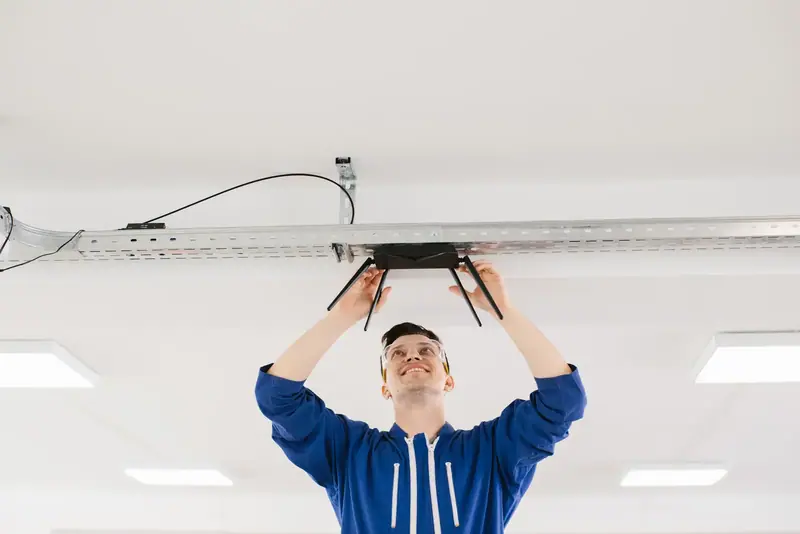
The first image shows an older ceiling-mounted unit of the kind that turns up on many repair calls. After years of lifting a door that has gradually gone out of balance, its internal gear is worn, its settings have drifted and it has started to make its displeasure known.
The comparison illustrates a correctly set up opener: centered on the door, rail straight and level, mounted on solid supports. In a typical repair we replace the worn internal parts, such as the drive gear, sprocket or trolley, rebalance the door so the opener is no longer overloaded, and reset the travel limits and force.
Afterward the opener runs with less effort and less noise, stops where it should, and reverses when it meets an obstruction. Fixing the door at the same time is what stops the new gear from wearing out like the old one.
Illustrative example. These are licensed reference photographs chosen to show the kind of change this service makes. They are not photos of a specific Nashotah Garage Door customer's property.
Repair or replace the opener?
We are glad to repair an opener that deserves it. Here is how we weigh it up.
Repair makes sense when:
- The unit is under roughly twelve to fifteen years old.
- It has photo-eyes and a working safety reversal.
- The fault is a wear part such as a gear, capacitor, trolley or sensor.
- Parts are readily available.
Replacement makes more sense when:
- It has no photo-eyes, or the reversal cannot be made to work reliably.
- The logic board has failed on an old unit and the part costs a large share of a new opener.
- It uses a fixed-code remote system that is easy to copy.
- The motor itself has failed.
- It is too noisy for a garage under living space, and quiet is the goal.
- You want features it cannot offer, such as battery backup or phone control.
Details of new units are on the opener replacement page.
Opener problems we see in Wisconsin winters
Cold-weather reversals. By far the most common winter call. The door becomes stiffer as lubricant thickens and steel contracts. An opener with its force set close to the limit reads the extra effort as an obstruction and reverses. The cure is to service the door, use low-temperature lubricant and reset the force properly. Turning the force up to maximum is not the answer and compromises safety.
Frozen-down doors. When the bottom seal is frozen to the slab, the opener pulls against an immovable door. This strips gears, bends the door arm and cracks top sections. If the door does not move on a freezing morning, do not press again. Release it and free the seal by hand.
Sluggish old motors. Grease inside an older opener's gearcase stiffens in an unheated garage, and the unit runs slow or stalls until it warms up.
Power surges. Winter storms and summer thunderstorms both damage logic boards. A surge protector on the opener's outlet is inexpensive protection.
Weak remote batteries. Batteries lose output in the cold. If the remote in the car stops working on cold mornings and recovers later, replace the battery.
Snow on the photo-eyes. A sensor knocked by a shovel or covered by drifted snow will stop the door closing. See sensor repair & alignment.
A few things to check before you call
You may be able to save yourself a visit.
- Is it plugged in, and does the outlet work? Try something else in the outlet. Check the breaker and any GFCI outlet on the circuit.
- Is the lock button on? Many wall consoles have a lock or vacation switch that disables the remotes.
- Are the photo-eyes lit steadily? A blinking or dark sensor light means the beam is blocked or misaligned.
- Has the trolley been disengaged? If someone pulled the red cord, the opener runs without moving the door. Re-engage it according to the manual.
- Is the remote battery fresh?
- Is the door itself locked? A manual slide lock will stop an opener cold.
If none of those is the answer, it is time for us to take a look.
Why opener repair is not a casual job
Opener repair has less stored-energy danger than spring work, but it is not without risk. The unit runs on mains voltage, the capacitor can hold a charge after the power is disconnected, and the work is done from a ladder under a door.
More important is what happens after the repair. The travel limits and closing force have to be set and then verified with a reversal test. An opener that has been reassembled and merely seems to work may not reverse on a child or a pet. We test it properly every time, and we will not leave an opener in service that fails.
Frequently asked questions
Most often the internal drive gear has stripped, or the start capacitor has failed. It can also mean the trolley has been disconnected from the door. Check the red release cord first.
The opener believes something is in the way. Check for blocked or misaligned photo-eyes. If they are fine, the door may be binding or the close limit and force may need adjusting.
Commonly ten to fifteen years, and longer on a well-balanced, well-maintained door.
If it has modern safety features and the fault is a wear part, usually yes. If it lacks photo-eyes or needs a costly board, replacement is the better value.
We service the common residential brands and drive types. For older or unusual models we will tell you whether parts can still be obtained.
Try a new battery, and check that the wall console's lock feature is off. If it still does not work, the remote may need reprogramming. See remote & keypad programming.