On a commercial door, the operator does the work a person would otherwise do with a chain or a strong back. It runs many more cycles than a residential opener, moves a much heavier door, and is expected to do so for years. It is built accordingly, with separate, serviceable components.
We repair commercial door operators for businesses and facilities around Nashotah. Most faults fall into a small number of categories, and most can be fixed without replacing the whole unit.
Types of commercial operator
| Type | How it drives the door | Typical use |
|---|---|---|
| Jackshaft | Mounted on the wall beside the door, it turns the door's shaft through a chain or direct coupling | High-lift and vertical-lift sectional doors, rolling steel doors |
| Trolley, or drawbar | Mounted overhead, it pulls the door along a rail, like a heavy-duty version of a house opener | Standard-lift sectional doors |
| Hoist | A jackshaft operator with a built-in hand chain for manual use | Where manual operation during an outage is important |
| Slide and direct-drive | Specialized units for sliding doors, high-speed doors and specific door makes | Particular applications |
Operators are also rated by duty. A light-duty unit is meant for a limited number of cycles per hour and per day. Asking it to run a busy bay shortens its life dramatically.
Inside the operator
Knowing the parts makes the diagnosis easier to follow.
Motor
Single-phase or three-phase, sized to the door. Protected by a thermal overload.
Gear reducer
Steps the motor speed down to door speed and multiplies torque.
Brake
Holds the door in position when the motor stops. Usually a solenoid-released friction brake.
Clutch
An adjustable friction clutch on many units, which slips if the door meets resistance.
Limit switches
Tell the operator where fully open and fully closed are. Mechanical cams or an electronic encoder.
Contactors and logic board
Switch the motor on, off and between directions, and process control inputs.
Transformer
Supplies low voltage to the control circuit.
Control station
Open, close and stop buttons, key switches, pull cords or radio receivers.
Entrapment protection
Photo-eyes and sensing edges that stop or reverse a closing door.
Manual release and hoist
A disconnect and hand chain for operating the door without power.
Faults we see most often
- Door stops short or overruns. Limit switches have drifted or a limit cam has slipped.
- Door drifts down after stopping. The brake is worn, contaminated or out of adjustment.
- Motor hums and trips out. A failed start capacitor on single-phase units, a seized gearbox, a lost phase on three-phase, or a door that is too heavy to move.
- Nothing happens at all. No power, a tripped overload, a blown control fuse, a failed transformer, or an open stop circuit.
- Door opens but will not close. Almost always the entrapment protection: photo-eyes misaligned, a damaged sensing edge or its cord, or a failed monitoring circuit.
- Door reverses on closing. Sensing edge fault, obstruction, or a binding door.
- Operator runs and the door does not move. A slipping clutch, a broken drive chain or sprocket key, or the manual disconnect left engaged.
- Works from one control and not another. A fault in a control station or its wiring.
- Erratic behavior after a storm. Surge damage to the logic board.
- Loud grinding or clunking. Worn gear reducer, dry or loose chain, or a failing bearing.
How we diagnose and repair
- 01
Lock out and make safe
Power is isolated and the door is secured before any covers come off.
- 02
Check the door first
The operator is disconnected and the door is tested for balance and free travel. A heavy or binding door is the root of many operator failures.
- 03
Verify the supply
Voltage, phases, fusing and overloads are checked.
- 04
Work through the control circuit
Stop circuit, control stations, interlocks, radio receiver and safety inputs are tested in sequence.
- 05
Inspect the mechanical drive
Brake, clutch, gear reducer, chain, sprockets, couplings and bearings.
- 06
Explain and quote
You are told what has failed, why, and what repair and replacement would each cost.
- 07
Repair
Faulty components are replaced, chains are tensioned and lubricated, brake and clutch are adjusted.
- 08
Set limits and test safety devices
Open and close limits are set. Photo-eyes and sensing edges are tested for correct stop or reverse.
- 09
Test manual operation
The disconnect and hoist are checked so the door can be worked by hand when needed.
Before & after
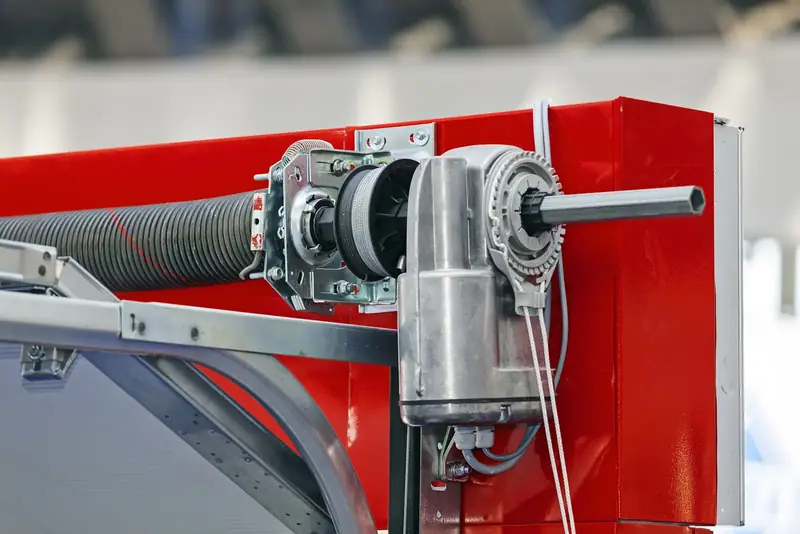
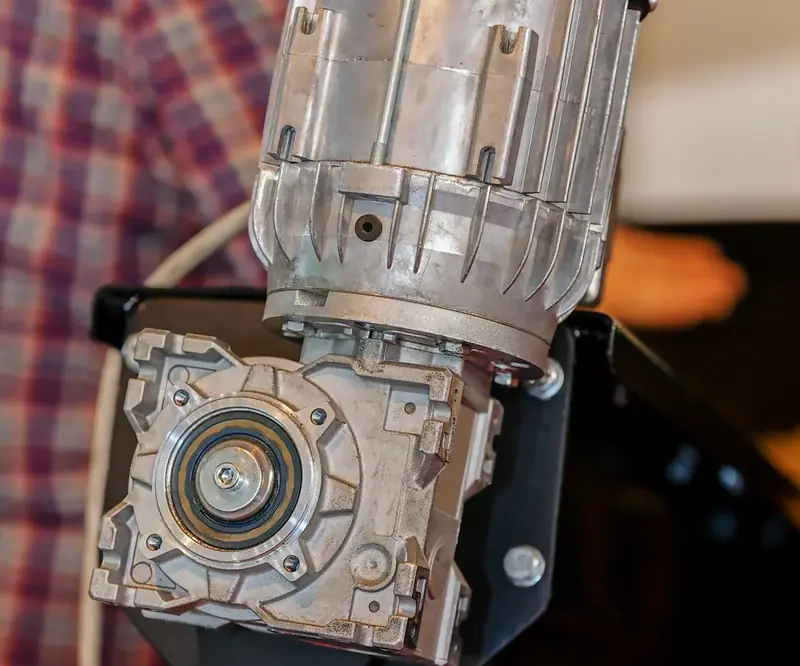
A worn operator gear motor compared with a properly mounted operator
Project notes
The first image shows an operator's gear motor out of service and on the bench. When a unit reaches this point, the cause is commonly a worn gear reducer, a failed brake or a motor that has overheated from moving a door its springs were no longer carrying.
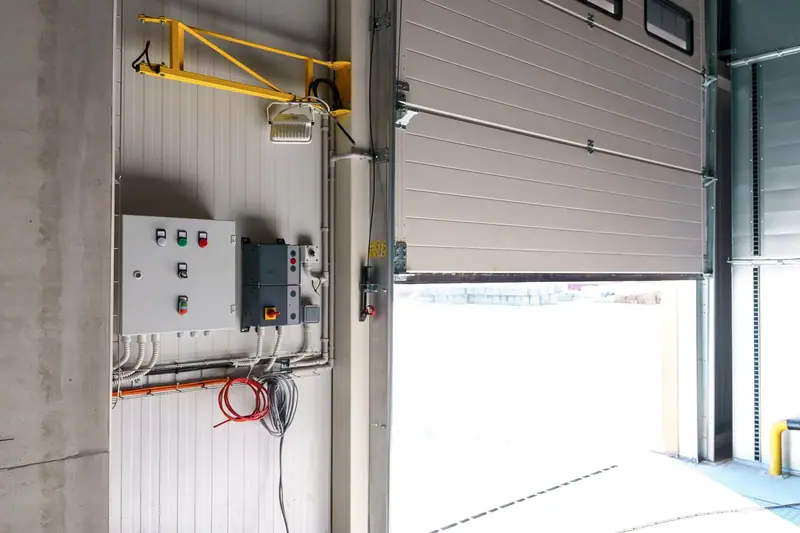
The comparison illustrates an operator as it should be: mounted solidly beside the door, coupled to the torsion shaft, with its manual hoist chain and wiring properly arranged. A repair may involve rebuilding or replacing the gear reducer, renewing the brake, resetting the limits and replacing worn drive chain or couplings. The door's balance is always checked and corrected alongside.
With the operator restored, the door starts and stops cleanly, holds its position, and its safety devices do their job. Just as usefully, the manual hoist works, so the door can still be opened if the power fails.
Illustrative example. These are licensed reference photographs chosen to show the kind of change this service makes. They are not photos of a specific Nashotah Garage Door customer's property.
Why the door matters as much as the operator
We make this point to every commercial customer. The operator is sized to move a balanced door. The springs carry the weight. As springs fatigue, the load on the operator climbs, and it responds by running hot, slipping its clutch, tripping its overload or wearing out its gears.
Replacing a burnt-out motor on a door with tired springs fixes nothing. The new motor inherits the same load. For that reason every operator repair we do includes a balance test, and if the door fails it we will tell you before spending your money on operator parts. See commercial door repair.
Safety devices and current standards
Commercial operators installed in recent years are required to have monitored entrapment protection if they close the door on a momentary button press or by remote. Monitored means the operator checks that the photo-eye or sensing edge is connected and working. If it is not, the door will only close under constant pressure on the button, with a person watching.
Many older operators predate this and close on a single press with no working safety device. If yours does, we can advise on adding compliant sensors or on a replacement operator. It is an area where an upgrade is worth far more than it costs.
Other points we check:
- Control stations are mounted in sight of the door and at a safe height.
- Pass-door interlocks prevent the operator running with a personnel door open.
- The stop button stops the door from every station.
- The manual release is reachable and labeled.
Repair or replace the operator?
Commercial operators are built to be repaired, and parts are available for many models long after manufacture. We lean toward repair when the motor and gear reducer are sound and the fault is in a brake, limit, contactor, board or sensor.
Replacement makes more sense when:
- The gear reducer and motor have both failed.
- Parts are no longer supplied.
- The operator is under-rated for the door's current use.
- It cannot be brought up to current safety requirements economically.
- Repeated repairs are adding up.
A new operator also brings options such as soft start, timers to close, better diagnostics and easier limit setting.
Operators in Wisconsin conditions
Cold. Gear oil and grease thicken in unheated buildings. Operators can run slowly or trip overloads on very cold mornings. Low-temperature lubricants and, in some cases, a heater kit address this.
Frozen doors. An operator will apply its full torque to a door frozen at the threshold. Something has to give: the clutch, a cable, the top section or the gearbox. Train staff to check for ice and not to hold the button.
Condensation. Temperature swings cause moisture inside control enclosures, leading to corroded terminals and erratic faults. Sealed enclosures and tidy cable entries help.
Power quality. Storms, and rural supplies at the end of a line, bring surges and voltage dips. Surge protection for the control circuit is cheap insurance, and a lost phase on a three-phase supply can destroy a motor if it is not protected.
Outages. A working manual hoist or release is essential. We test it on every visit.
Dust and agriculture. Dusty and corrosive environments call for sealed enclosures and more frequent inspection.
Looking after an operator
- Keep the drive chain lubricated and correctly tensioned.
- Have the brake and clutch checked and adjusted periodically.
- Test the photo-eyes and sensing edge monthly.
- Check that the manual release and hoist operate.
- Keep the control enclosure closed and dry.
- Have the door's balance tested at least yearly.
These are covered in a scheduled service visit. See commercial maintenance.
Why this needs a specialist
Operator work combines electrical and mechanical hazards. Many units run on 208, 230 or 460 volts, some on three-phase. Control circuits include safety interlocks that must not be bridged. The operator is connected to a door weighing hundreds of pounds, and releasing a brake or disconnecting a drive at the wrong moment lets that door move.
A qualified technician isolates the supply, secures the door, diagnoses methodically and tests the safety systems afterward. That last step is the one that protects the people who use the door every day.
Frequently asked questions
The closing safety circuit is usually the cause: misaligned photo-eyes, a damaged sensing edge or cord, or a monitoring fault. The door may still close under constant pressure on the button.
The operator's brake is worn or out of adjustment, or the door is out of balance. Both should be checked.
We work on the common commercial makes and types. For older or unusual units we will confirm whether parts are available.
If the motor and gearbox are sound, repair is usually worthwhile. If major components have failed or it cannot meet current safety requirements, replacement is the better investment.
Use the manual release and hand chain or hoist fitted to the operator. If you are unsure how, we will show your staff during a visit.
At least annually, and more often for doors with heavy daily use.