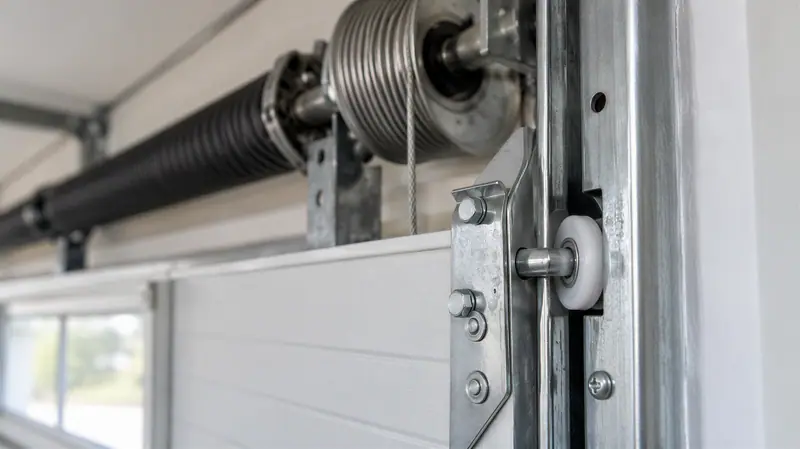
Most people have never heard of a cable drum until one fails. They are the grooved, wheel-shaped castings at the two ends of the shaft above your garage door, and each one reels in a lift cable as the door opens.
We replace garage door drums for homeowners in Nashotah and nearby. It is a smaller repair than a spring replacement, though it involves the same safety procedures, and it often solves problems that have been blamed on other parts.
What a drum does
On a torsion spring door, the spring turns the shaft. The drums are locked to the shaft with set screws, so they turn with it. Each drum has a spiral groove cut into its surface, and the lift cable from the bottom corner of the door lies in that groove, one wrap beside the next, as the door goes up.
Three things about the drum matter.
- Its diameter sets how much cable is taken up per turn and how much leverage the spring has. Springs are calculated for a particular drum.
- Its groove pattern keeps the cable in a single neat layer. Cable that piles up on itself changes the effective diameter and makes the door lift unevenly.
- Its grip on the shaft has to be absolute. If a drum slips even slightly, that side of the door drops relative to the other.
Drums are left- and right-handed, and they are sold in matched pairs.
Types of drum
| Drum type | Where it is used | Notes |
|---|---|---|
| Standard lift | Most residential doors, where the track curves back just above the opening | A plain spiral groove of constant diameter |
| High lift | Garages with tall ceilings, where the door travels up the wall before turning back | Part flat groove, part tapered, sized to the amount of high lift |
| Vertical lift | Doors that rise straight up the wall, mostly commercial | Fully tapered to keep the door balanced through its travel |
Using the wrong drum for the track layout makes it impossible to balance the door. If your garage has been converted to high-lift track at some point, the drums should have been changed with it. We check.
How drums fail
Cracked flange or hub
Cast aluminum can crack from age, an overtightened set screw or the shock of a spring breaking. A cracked drum can let go of the shaft or the cable.
Worn grooves
Years of cable running in the same path wear the groove edges sharp or uneven. Sharp edges cut cable strands.
Stripped set screws
The screws that lock the drum to the shaft loosen or strip, and the drum begins to slip.
Scored shaft
If a drum has been slipping, it chews a ring into the shaft. A new drum needs sound metal to grip.
Damaged cable anchor
The slot that holds the cable end can deform, allowing the cable to pull free.
Corrosion
In damp garages the surface pits and roughens, and the steel set screws rust in place.
Symptoms that point to the drums
Drum problems are often mistaken for cable or spring problems. These are the tell-tale signs.
- One side of the door is higher than the other, and it keeps going out of level after being reset.
- New cables have frayed again within a year or two, always in the same place.
- Cable is stacking up on one drum or riding off the end.
- There is a clicking or popping from one end of the shaft as the door moves.
- You can see a crack in the casting, or shiny wear marks on the shaft beside the drum.
- The door shudders at the same point in every cycle.
Our replacement process
- 01
Secure the door and disconnect the opener
The door is clamped closed so nothing can move unexpectedly.
- 02
Unwind the torsion springs
Tension is released a quarter turn at a time with winding bars. Nothing on the shaft can be touched safely until this is done.
- 03
Remove cables and old drums
Set screws are backed out, cables are unhooked and the drums are slid off the shaft.
- 04
Inspect the shaft and bearings
We check the shaft for scoring, bends and burrs, and the end bearings for roughness. Burrs are dressed so the new drum seats on clean metal.
- 05
Fit matched new drums
A left and right drum of the correct type and size go on, positioned against the end bearing plates.
- 06
Install new cables
New cables are anchored and wrapped into the first groove. We do not put old cable onto new drums.
- 07
Set, tighten and equalize
Both cables are pulled to equal tension, and the set screws are tightened firmly without crushing the shaft.
- 08
Rewind, balance and test
Springs are wound back to specification, the door is balanced by hand and then run under the opener while we watch the cables track.
Before & after
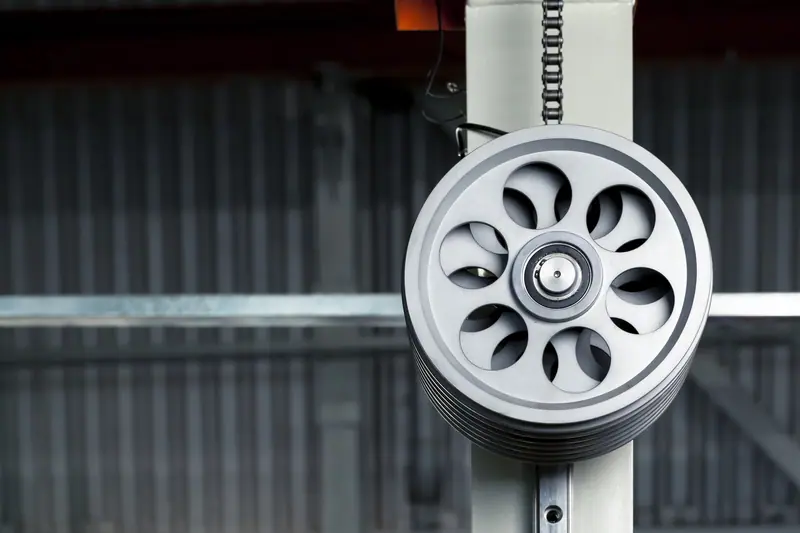
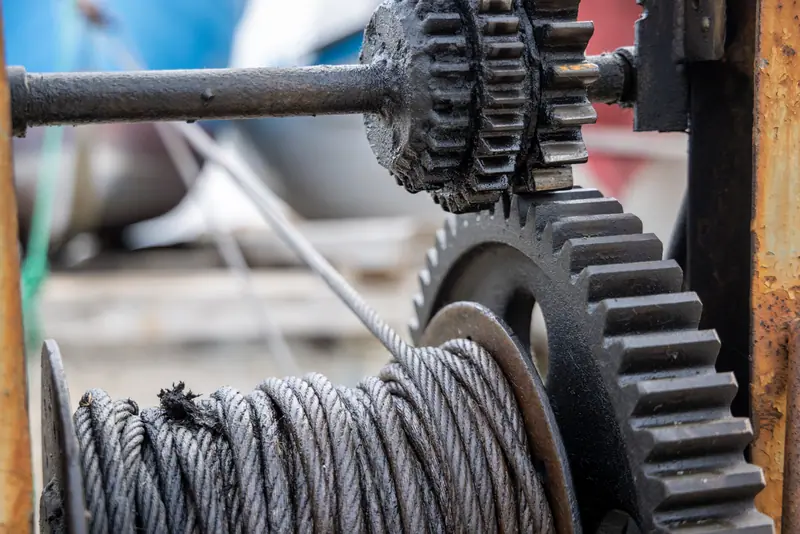
A corroded drum with frayed cable compared with a clean, true-running wheel
Project notes
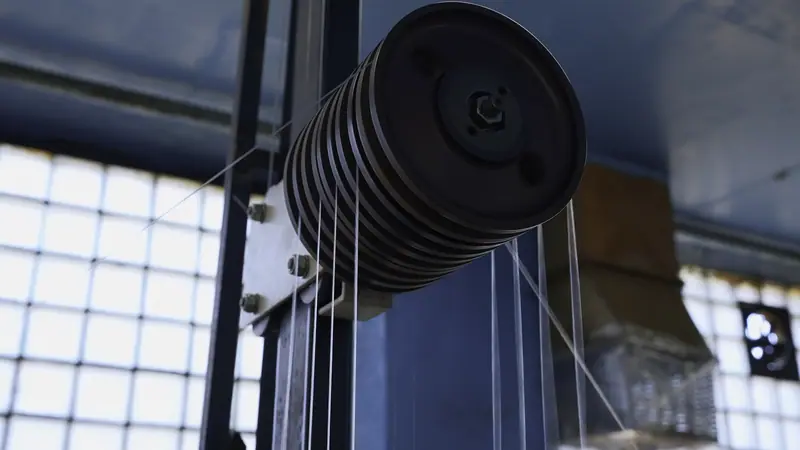
The first image is a heavy industrial example, but it shows the failure clearly: a corroded drum, cable wound unevenly across it, and strands beginning to break where they ride over rough metal. On a garage door the scale is smaller and the pattern is the same. A damaged groove or a rusty surface eats the cable that runs on it.
The second image illustrates what a sound winding surface looks like: clean, smooth and true, with nothing to snag a strand. On a garage door, replacement means fitting a new pair of cast drums matched to the door's height and lift type, with new cables seated in the grooves and the set screws tightened onto the shaft.
With good drums the cables wind neatly, both sides of the door rise together, and the cables last as long as they should.
Illustrative example. These are licensed reference photographs chosen to show the kind of change this service makes. They are not photos of a specific Nashotah Garage Door customer's property.
Why drums and cables are replaced together
A worn drum damages cable, and a damaged cable has usually marked the drum. Fitting one new component against one old one tends to transfer the wear straight across. When a drum is replaced, we fit new cables. When cables are replaced, we inspect the drums closely and tell you if they are fit to continue. Often they are. When they are not, changing them at the same visit adds little, because the springs are already unwound.
How much to tighten a set screw
It sounds like a trivial detail, and it is the one that causes the most trouble. Too loose, and the drum creeps on the shaft until the door is crooked. Too tight on a hollow shaft, and the screws dimple and distort the tube, which makes the drum sit off-center and makes future adjustment difficult. On a solid or keyed shaft the method is different again. We tighten to suit the shaft type, and we check that both drums have ended up at the same rotational position so the door starts level and stays level.
Drums in a Wisconsin garage
Condensation. The shaft and drums sit at the top of the opening, where warm, moist air from a wet car collects against cold metal. Aluminum drums do not rust, but they do corrode to a rough white surface over the years, and the steel set screws rust in their threads.
Frozen-door incidents. When an opener is run against a door frozen to the floor, the shaft turns and the door does not. Cables unwrap and tangle on the drums, and the sudden shock when the door breaks free can crack a casting. This is one of the most common ways drums are damaged in winter.
Spring breaks in the cold. A spring snapping sends a jolt down the shaft. We always inspect the drums after a spring failure.
Heavier doors. Insulated and wood doors, popular here for good reason, put more load on drums and cables. If a light door has been replaced with a heavy one, the original drums may not be the right specification.
Is this something a homeowner can do?
No, and for the same reason as springs. The drums cannot be removed, adjusted or even loosened without first releasing the torsion springs. Loosening a drum set screw on a wound system lets the shaft spin free and the door drop. It is one of the more serious mistakes we see.
Beyond safety, selecting the right drum takes knowledge of the door height, track type and spring calculation. A drum that looks similar but has a different diameter will throw the balance off, and the door will never feel right.
Related repairs
Drum replacement often goes hand in hand with other work. If your door has been lifting unevenly for a while, it may also need new cables, attention to the tracks, or an off-track correction. When the springs are at the end of their life, combining a torsion spring replacement with new drums and cables renews the whole lifting system in one visit.
Frequently asked questions
Look for a door that keeps going out of level, cables that fray repeatedly, cable piling up or riding off the drum, or a visible crack in the casting. A clicking sound from the end of the shaft is another clue.
No. They commonly last the life of the door. They are usually replaced because of damage from a spring break, a frozen-door incident or long-term cable wear.
Yes. They are made as a matched left and right pair, and they must be identical in size for the door to lift level.
We recommend it. Old cable has worn to the shape of the old drum and may be damaged where it ran over the faulty groove.
Sometimes, if the shaft is not scored and the casting is sound. If the shaft has been chewed where the drum slipped, the drum must be repositioned on clean metal or the shaft replaced.
Usually around an hour to an hour and a half, as the springs have to be unwound and rewound.