A garage is an attractive target. It holds tools, bikes and vehicles, it often has a door into the house, and its main door is a large, thin panel that many people do not think of as a security barrier.
We repair garage doors after break-ins and attempted break-ins for homeowners and businesses around Nashotah. Our job is in two parts: repair what was damaged, and make it more difficult next time.
First steps after a break-in
- If there is any chance someone is still inside, do not go in. Call 911 from a safe place.
- Report it to the police before anything is moved or repaired. Ask for the report number.
- Photograph the damage to the door, lock, track and frame, inside and out.
- Note what is missing, including any garage door remotes taken from vehicles.
- Contact your insurer. They will usually want the police report number and the photos.
- Then call us to secure and repair the door.
Please do not start repairs until the police have seen the scene, unless they tell you otherwise.
How garage doors are forced
Knowing the methods helps explain the repairs and the prevention.
Fishing the emergency release
A wire or hook is pushed through the gap at the top of the door to snag the red release cord, disconnecting the opener so the door can be lifted. Quick and quiet.
Prying the bottom or side
A bar is forced under the door or between the door and the jamb to lift or bend it.
Kicking in a panel
Thin, uninsulated sections can be bent or broken to reach inside.
Breaking a window
Glass in the door or a side window is broken to reach the release or a lock.
A stolen or copied remote
A remote taken from an unlocked car, or an old fixed-code remote copied.
A weak or shared keypad code
Obvious codes, or codes that have been given to too many people.
Forcing the side entry door
Often the real weak point. A hollow door with a basic latch.
An open door
The simplest of all. Doors left open in the evening or overnight.
Damage we typically repair
- Bent or creased sections, especially the bottom and top.
- Bent track and brackets where the door was levered.
- Damaged bottom seal and retainer.
- Broken locks, latches and handles.
- Rollers pulled from the track, leaving the door off its rails.
- Broken glass in window sections.
- Bent opener arm or damaged top bracket where the door was forced against the opener.
- Stripped opener gear, if the door was lifted against the drive.
- Damaged jambs and stop molding.
- Cables off their drums after the door was lifted unevenly.
Our repair process
- 01
Secure the opening
If the door cannot be closed and locked, we make it secure straight away, by repairing enough to close it or by bracing it shut.
- 02
Inspect thoroughly
Break-ins often cause hidden damage. We check every section, the track, rollers, cables, springs and opener.
- 03
Document for your claim
We can provide a written description of the damage and an itemized estimate for your insurer.
- 04
Repair or replace sections
Damaged sections are replaced with matching ones where available, or reinforced where the damage is light. See panel repair & replacement.
- 05
Restore the track and hardware
Bent track is replaced, rollers and hinges renewed, cables reseated.
- 06
Repair the opener
Arm, bracket, gear and settings are put right and the safety reversal is tested.
- 07
Replace locks and reset access
New locks where fitted, opener memory cleared, remotes and keypad reprogrammed.
- 08
Fit security upgrades
With your agreement, we address the method that was used. See below.
- 09
Test
The door is run, locked and checked from outside for gaps and movement.
Before & after
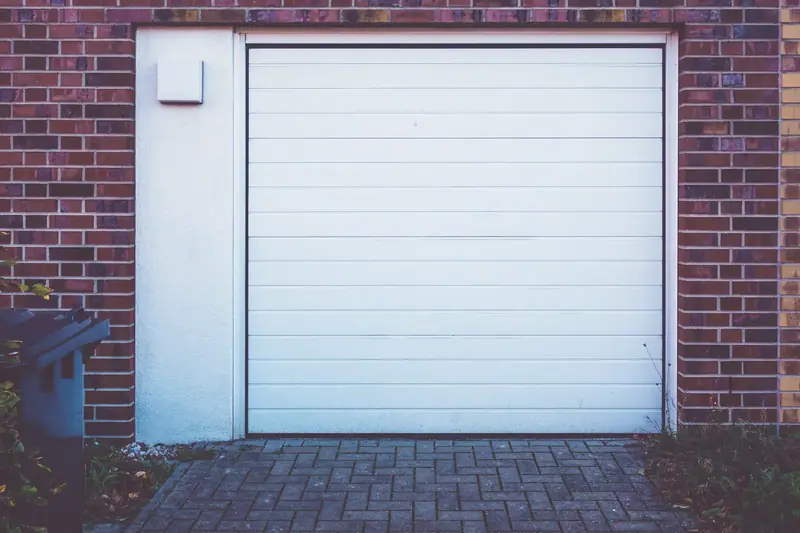
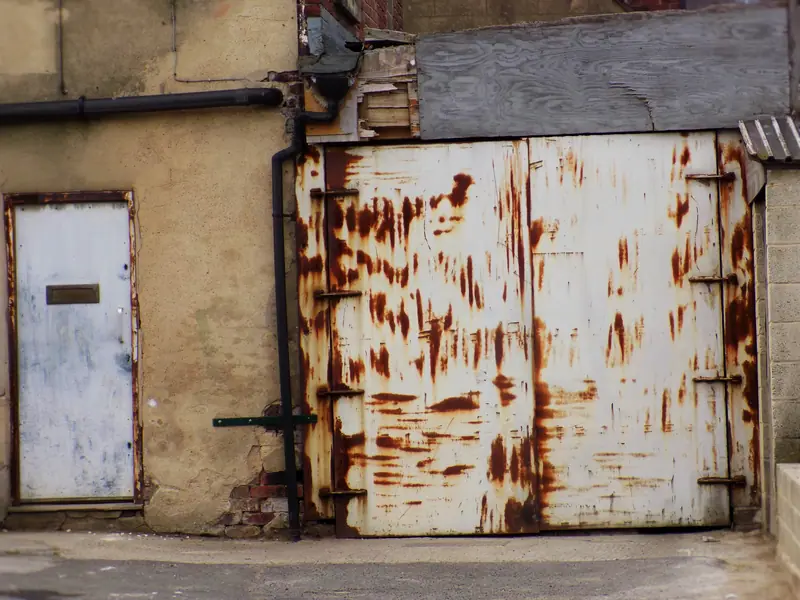
A forced, battered door compared with a solid, secure one
Project notes
The first image shows a steel door that has been abused: the edge is bent, the surface is rusted and distorted, and it no longer meets its frame. Whether the damage came from a forced entry or from years of neglect, the result is the same, an opening that cannot be trusted to keep anyone out.
The comparison illustrates a door that does its job: flat, intact, seated firmly in its opening on all sides. After a break-in, getting there can mean replacing bent sections, straightening or renewing track, fitting a new lock or latch, and replacing damaged weatherstripping. Where the door was weak to begin with, a replacement in a heavier, insulated construction is sometimes the right answer.
The owner ends up with more than a repair. The opening is secure again, the method used to get in has been closed off, and the remotes and codes are known and accounted for.
Illustrative example. These are licensed reference photographs chosen to show the kind of change this service makes. They are not photos of a specific Nashotah Garage Door customer's property.
Making the door harder to defeat
None of these is expensive, and together they change the picture considerably.
Protect the emergency release
A simple shield over the release mechanism prevents a wire from hooking it, while leaving it fully usable from inside. Never disable or tie off the release itself. It is a safety device for getting out.
Close the gap at the top
A properly adjusted door sits tight against the header weatherstripping. If there is a visible gap along the top, track adjustment and new stop molding remove the access point.
Reinforce the door
Horizontal struts stiffen the sections and make prying and kicking much less effective. An insulated, triple-layer door is inherently far stronger than single-skin steel.
Use the opener's own security
Modern openers with rolling-code remotes cannot be opened by a copied code. Many have a lock or vacation setting on the wall console that disables all remotes while you are away. Some include an automatic deadbolt that engages each time the door closes.
Clear and reprogram
After any break-in, and whenever a remote is lost, erase the opener's memory and reprogram only the remotes you hold. Change the keypad code. See remote & keypad programming.
Add a manual lock for when you are away
A slide lock inside the door gives a physical barrier. It must be unlocked before the opener is used, so it suits holidays and seasonal properties more than daily use. Interlock kits are available that prevent the opener running while the lock is engaged.
Know when the door is open
A connected opener or add-on sensor tells you if the door has been left open and can close it automatically at night. See smart opener installation.
Do not forget the other doors
- Fit a solid door with a deadbolt between an attached garage and the house, and lock it.
- Give the garage's side entry door a deadbolt and a reinforced strike plate.
- Cover or frost garage windows so the contents cannot be seen.
- Add motion lighting over the driveway.
Do not leave the remote in the car
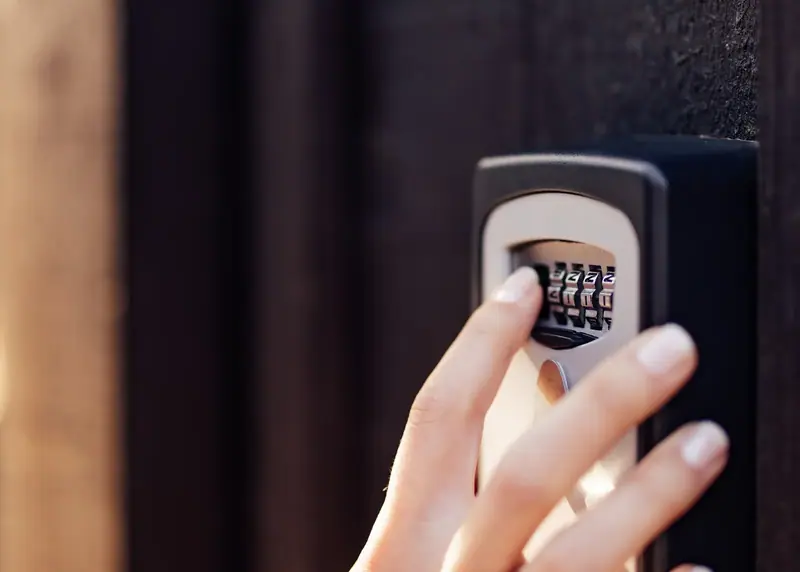
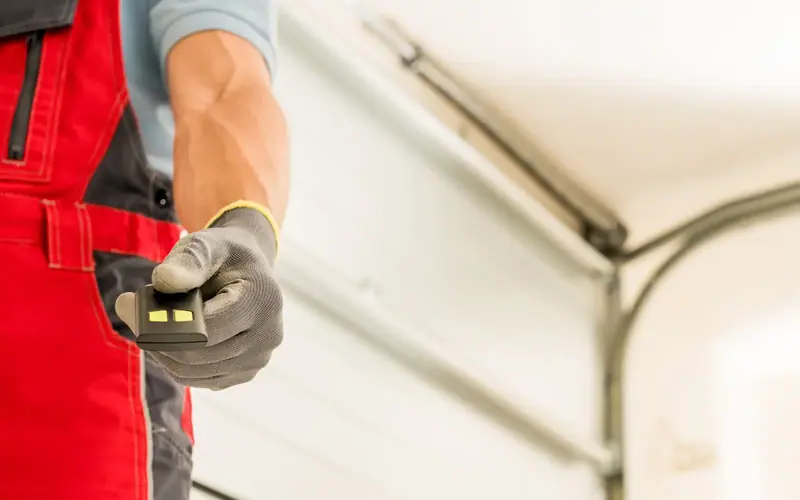
A remote on the visor of an unlocked car in the driveway is a key to the house. Use a key-ring remote, or the car's built-in button, which only works with the ignition on in many vehicles.
Repair or replace after a break-in?
If the door was sound and the damage is limited to a section, a lock and some track, repair is the sensible route. If the door was old, thin and easily bent, a break-in is often the moment owners decide to replace it with something stronger. An insulated steel door with a modern opener is a substantial upgrade in security as well as comfort. We will price both so you can compare. See garage door replacement.
Seasonal and lake properties
The area around Nashotah has many homes and garages that are unoccupied for part of the year, along with boathouses and storage buildings. They are more exposed simply because nobody is there to notice.
For these we suggest a combination: a manual lock engaged for the off-season, the opener's vacation lock switched on or the unit unplugged, a connected sensor that alerts you if the door opens, and lighting on a timer or motion sensor. Ask a neighbor to look at the door now and then, particularly after storms.
Winter considerations
Securing a damaged door in the cold. A door that cannot close lets freezing air into the garage, and into the house if it is attached. Getting it shut and sealed quickly protects pipes as well as property.
Parts and matching. If a replacement section has to be ordered, we secure the existing door so it is weathertight in the meantime.
Frozen or stiff locks. Manual locks and T-handles can freeze. A dry graphite or lock lubricant applied before winter keeps them working. Do not force a frozen key.
Short days. Long hours of darkness give more cover. Lighting earns its keep from November to March.
Why professional repair matters here
A forced door is frequently out of balance, off its track or carrying a slack cable, which makes it hazardous to move. It needs to be made safe before it is made secure.
Beyond that, a door company can see how the entry was made and close that route. Replacing a bent panel without fitting a release shield or adjusting the gap leaves you where you started. And a proper, itemized estimate from a specialist makes the conversation with your insurer much simpler.
Frequently asked questions
The police, unless there is an immediate safety hazard. Get a report number, take photographs, then call us to secure and repair the door.
Many homeowner policies cover damage from forced entry, subject to your deductible and terms. Check with your insurer. We can provide an itemized estimate and description of the damage.
Securing the opening is always the first priority. Tell us the situation when you call and we will explain what we can do and when.
The usual methods are hooking the emergency release through the top gap, using a stolen remote or guessing a keypad code. All three can be addressed.
No. It is needed to get out in a power failure or emergency. Fit a shield that blocks access from outside instead.
Not necessarily. If it uses rolling-code remotes, clearing its memory and reprogramming is enough. If it is an old fixed-code unit, replacing it is worthwhile.