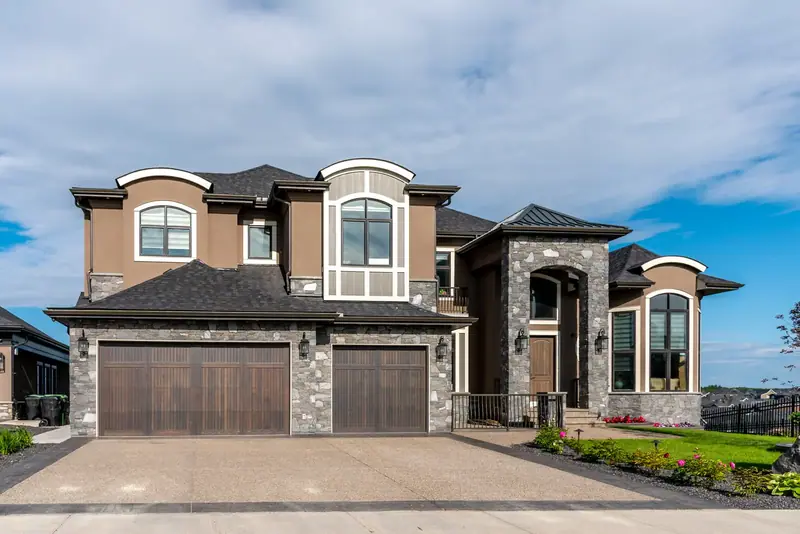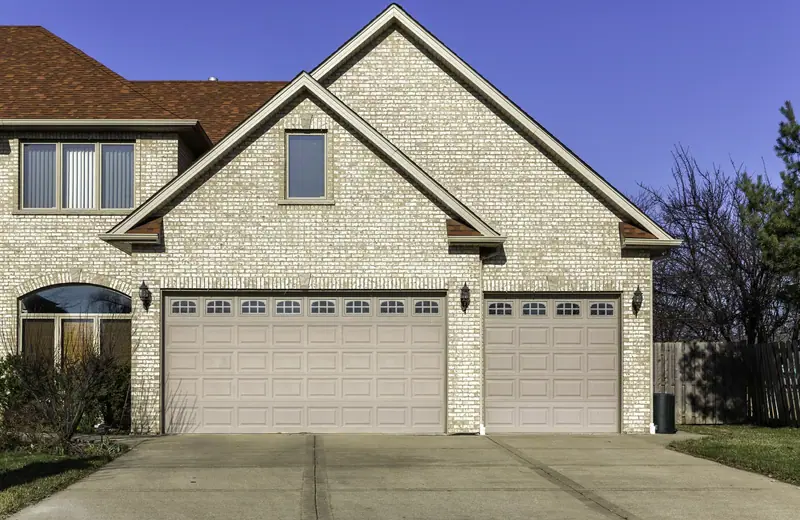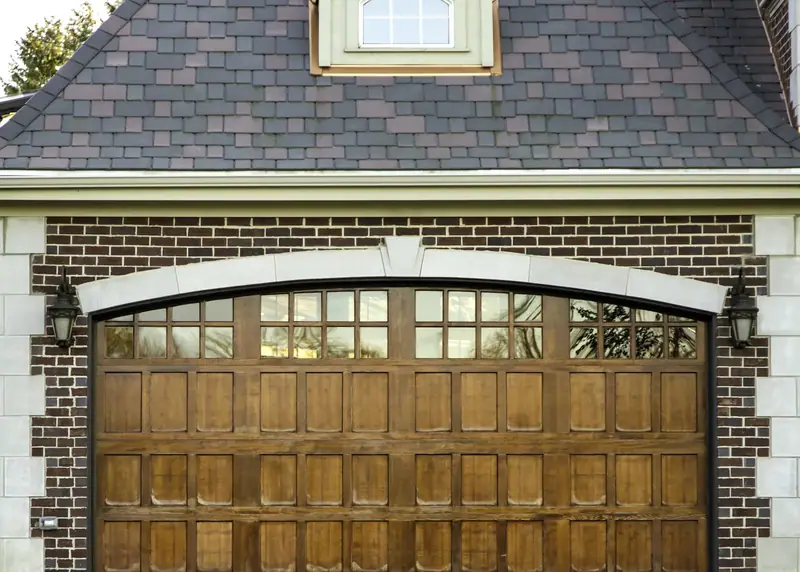
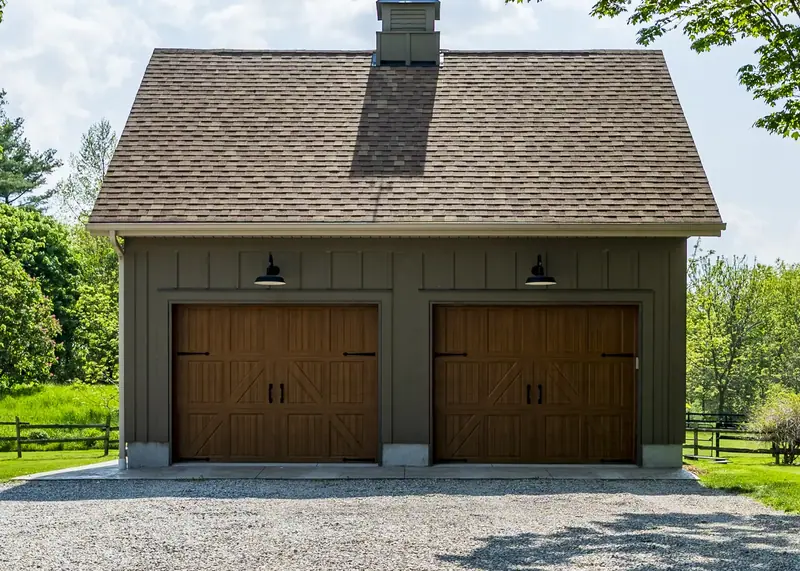
Before cars, the building beside the house was for a carriage, and its doors swung outward on long iron hinges. That look has never really gone out of favor, and around the lakes it suits a great many homes: shingled cottages, farmhouses, craftsman bungalows, stone-and-timber lodges.
Modern carriage house garage doors give you that appearance on a door that works the way you expect a garage door to work. We supply and install them throughout Nashotah and the surrounding area.
What makes a door “carriage house”
The style is defined by a handful of features. Not every door has all of them, and choosing which to include is how you tune the look.
- A center division. A vertical stile or a pair of handles in the middle suggests two doors meeting, even on a single wide door.
- Frame-and-panel layout. Raised stiles and rails surround recessed fields, often filled with vertical boards.
- Bracing. Diagonal, X-shaped or Z-shaped braces, borrowed from barn doors, on some or all of the panels.
- Top windows. A row of square or arched lites across the upper section, usually divided by grilles.
- Decorative hardware. Strap hinges at the outer edges and handles or ring pulls at the center. They are ornamental, but they do most of the persuading.
- An arched top. Either a true arched opening or an arch drawn in the overlay and glass.
Put together well, the horizontal joints between sections disappear into the design. From the street you see doors that swing. From inside you see a normal sectional door.
Three ways to build one
Stamped steel
The carriage pattern is pressed into an insulated steel door. The most affordable option, low maintenance and widely available. Detail is shallower than an overlay door.
Steel with overlay
Composite or PVC boards are applied over an insulated steel base to create real depth and shadow lines. The most popular choice: convincing, durable and easy to keep.
Real wood
Solid or wood-faced construction in cedar, fir, mahogany or similar. The richest look and the highest upkeep. See custom wood doors.
There are also fiberglass and all-composite versions that mimic wood grain and resist moisture, which can make sense on shaded lake lots.
Getting the design right for your house
A carriage door can look perfectly at home or slightly costume-like, and the difference is in a few decisions.
One door or two
On a two-car garage, a pair of single doors nearly always looks more authentic than one wide double, because real carriage doors were never sixteen feet across. If you have a double opening and do not want to reframe it, a double door designed as two pairs, with a strong center post detail, is the next best thing.
Scale of the pattern
Tall, narrow panels suit taller doors and vertical architecture. On a standard seven-foot door, keep the layout simple. Too many braces and grilles on a small door get busy.
Windows
Match the grille pattern to the house windows where you can. Arched lites soften a boxy garage. If privacy matters, frosted or seeded glass keeps the light without the view.
Color
Two-tone schemes, with the overlay trim in a contrasting color to the field, emphasize the pattern and suit farmhouse styles. A single color is calmer and lets the hardware do the work. Stained wood tones pair well with stone and dark trim.
Hardware
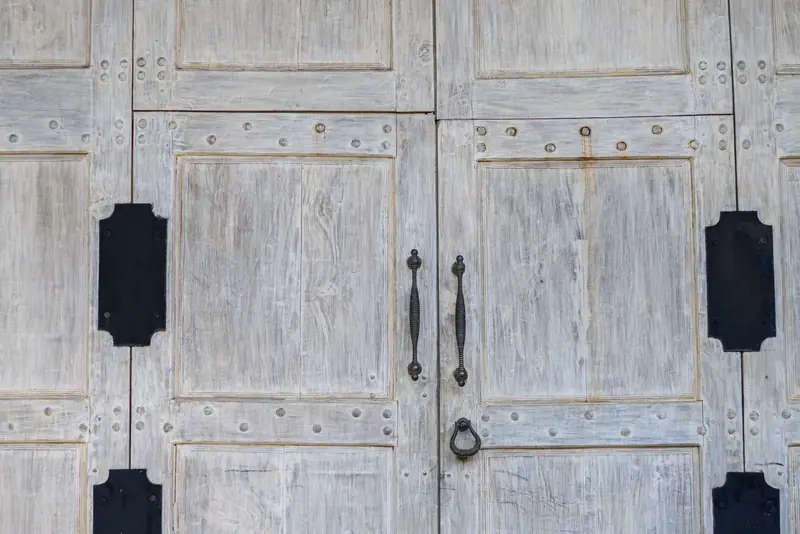
Choose hinges and handles in proportion to the door, and place them where real ones would be. Black is traditional. Hand-forged textures look right on rustic homes, while slimmer, cleaner pieces suit a modern farmhouse.
Where they suit, and where they do not
Carriage house doors are flexible, but they are not universal. They flatter craftsman, cottage, colonial, farmhouse, Tudor and lodge-style homes. They can look out of place on a sharply modern build or a low mid-century ranch, where a contemporary or simple raised-panel door is usually the better fit. If we think another style would serve your house better, we will tell you and show you why.
Before & after
Weathered swing doors compared with a new carriage house design
Project notes
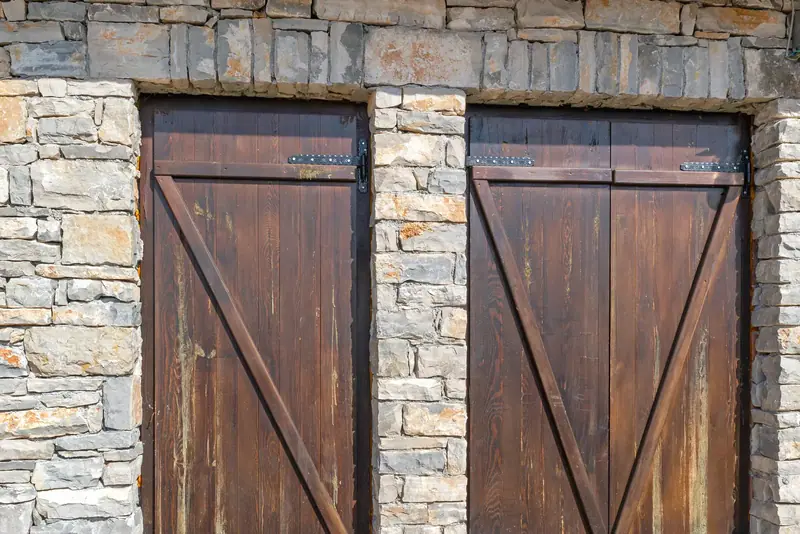
Genuine swing doors like the pair in the first image are where the carriage house style comes from. They are also hard to live with. The boards have weathered gray and opened along the grain, the doors have dropped on their hinges, and there is no way to seal them or fit an opener without rebuilding them.
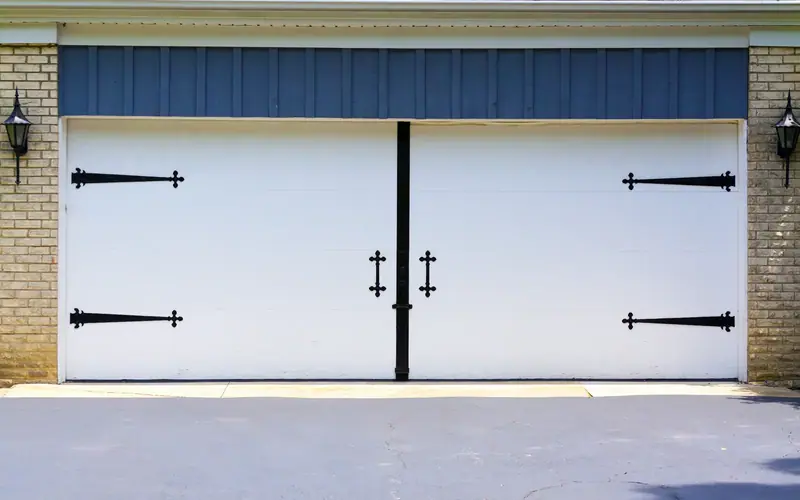
The comparison shows the modern equivalent: an insulated overhead door faced to look like a matched pair of swing doors. A center stile gives the impression of two leaves, overlay boards create the frame-and-panel pattern, and black strap hinges and ring pulls complete the picture.
The building keeps its period look from the road. The owner gains a door that seals, insulates, locks and opens from the car, and snow piled in front of it no longer matters.
Illustrative example. These are licensed reference photographs chosen to show the kind of change this service makes. They are not photos of a specific Nashotah Garage Door customer's property.
How they perform in Wisconsin weather
A carriage house door from a good manufacturer is first of all an insulated sectional door, so it brings everything discussed on the insulated doors page: a foam core, thermal breaks and sealed section joints.
A few points are specific to the style.
Overlay boards and moisture. Composite and PVC overlays do not absorb water, so they cope well with snow piled against the door and with damp lake air. Real wood overlays need their finish kept up, especially the lower rail where splashback hits.
Dark colors and sun. Overlay materials expand in heat. On a south or west exposure, some manufacturers limit how dark the overlay can be. We check this for your orientation before you choose a color.
Hardware and salt. Decorative hinges and handles are usually powder-coated steel or aluminum. They hold up well, but road salt carried in on tires does end up on the lower hardware. A rinse in spring keeps them looking fresh.
Weight. Overlay and wood doors are heavier than plain steel. Springs, track and opener are sized for that weight, and we lean toward high-cycle springs so you are not replacing them early.
Installation notes
Installing a carriage house door follows the same sequence as any sectional door, with extra attention in three places.
- Reveals. Because the design depends on symmetry, the gap between the door and the trim has to be even on both sides and across the top. We set the track to achieve that, not just to make the door operate.
- Hardware placement. Hinges and handles are mounted after the door is hung, measured from the door edges so they line up across a pair of doors. Handles must clear the header and trim when the door opens.
- Balance. A heavier door needs exact spring tension. We test it at several heights by hand before the opener is connected.
Some doors can be ordered with the hardware supplied loose so you can decide on placement once you see the door in the opening. We are happy to tape it in position and let you step back to the road before we drill.
Upkeep
Steel and composite carriage doors need very little: a wash with mild soap twice a year, a look at the caulk lines on the overlay, and normal mechanical maintenance. Stained wood doors should be inspected each spring and recoated when the finish begins to dull, before bare wood is exposed. Decorative hardware fasteners are worth a check every year or two.
Why have it professionally installed
The appeal of a carriage house door is visual, and small errors show. A door hung a quarter inch out of level makes the center line lean. Hinges set at slightly different heights on two neighboring doors catch the eye every time you pull in. On top of that, these are heavy doors with strongly wound springs, and balancing them safely is specialist work. Good installation is what makes the door look the way it did in the brochure.
Frequently asked questions
The doors we are describing do not. They are sectional overhead doors designed to look like swing doors. True swing-out doors can be built, but they need clear space in front and are harder to seal and automate, which is a real drawback with Wisconsin snow.
Stamped-steel versions are priced close to other insulated steel doors. Overlay doors cost more, and real wood costs the most. We can quote a few levels so you can see the difference.
Yes. Decorative hinge and handle kits can be fitted to many plain doors and make a noticeable difference for little money. It will not create the paneled look, but it is a pleasant upgrade.
No, it is ornamental. The door still opens from the opener or the interior lift handle.
Yes. Frosted, seeded and obscure glass options let light in while blurring the view. Placing the windows in the top section also keeps them above eye level.
Usually, if the opener is in good condition and rated for the door's weight. Heavier overlay and wood doors sometimes need a stronger unit, and we check that as part of the quote.